
Window Well Covers — Complete Guide
Every spring in Minneapolis, melting snow finds the lowest point around your foundation, and that point is often a basement window well. Window well covers are one of the simplest defenses against the flooding, debris buildup, and ice damage that hit basement windows hardest between March and May. However, not every cover does the same job, and the wrong one can trap water instead of shedding it. This guide explains when a cover makes sense, which materials hold up to Minnesota freeze-thaw cycles, and how sizing and installation affect whether it actually works. By the end, you should know which style fits your well, your budget, and your flood risk.
What You'll Find in This Guide
- Polycarbonate Window Well Covers: Durability, Light, and Minneapolis Freeze-Thaw
- Window Well Covers Materials: Which Type Fits Minneapolis Homes and Budgets
- Window Well Covers Terms Explained: A Plain-English Glossary
- How Much Do Window Well Covers Cost?
Do Window Well Covers Actually Stop Flooding?
The short answer is yes, for the most common cause of window well flooding. Most water that ends up in a well does not rise from below. Instead, it falls in from above as rain, roof runoff, or snowmelt, then pools against the window until the seal fails. A properly fitted cover blocks that surface water at the top of the well before it can collect. For a Minneapolis homeowner who has already bailed out a well with a bucket during a March thaw, that is the difference between a dry basement and a wet one.
That said, a cover is not a cure-all. If your well floods because the drain at the bottom is clogged or was never connected, water can still enter from the sides and below. In that case, the cover buys you time but does not fix the root problem. A good rule: if water appears in the well during heavy rain but not during dry weeks, a cover will likely solve most of it. If water seeps in slowly even without rain, you have a drainage issue that needs attention first.
Debris Is the Hidden Flood Cause
Beyond direct rainfall, debris causes more well flooding than most homeowners realize. Leaves, mulch, and grass clippings blow into an open well all season. Over time, they settle into the gravel and choke the drain. As a result, the next storm has nowhere to send its water, and the well fills like a bathtub. A cover stops that cycle before it starts, which is why even homeowners with working drains benefit from one.
Ice adds a second layer of risk in Minnesota. Snow that accumulates in an open well melts and refreezes against the window frame, stressing seals and cracking older glass. A sloped cover sheds snow instead of collecting it. If freeze-thaw durability is your main concern, our guide to polycarbonate window well covers in Minneapolis walks through how that material handles repeated winters. For most Emergency Water Fighters, the flood question settles the "do I need one" debate quickly. The harder question is which cover to buy, and that comes down to material and fit.
Comparing Window Well Cover Materials and Styles
Covers come in four broad material families, and each solves a different problem. Choosing well means matching the material to your specific risk, not just picking the cheapest option at the hardware store.
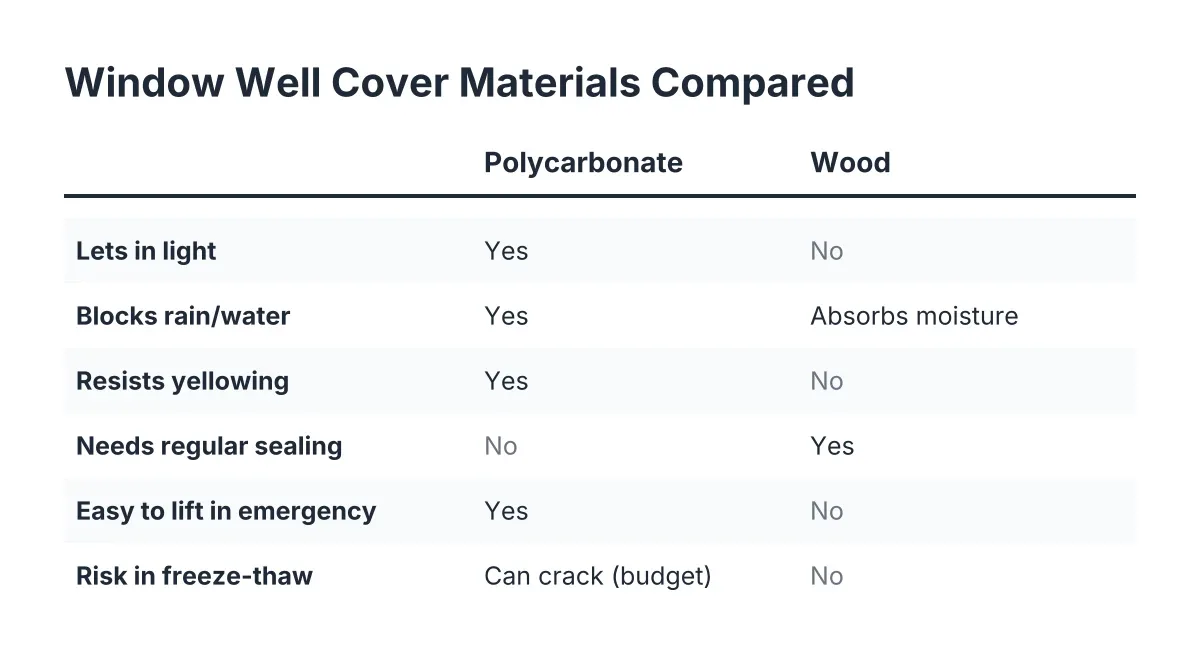
Polycarbonate is the most popular choice in Minneapolis for a reason. It sheds water completely, lets daylight into the basement, and resists cracking in cold weather. Additionally, clear domed versions handle snow load better than flat plastic sheets. Metal grates sit at the other end of the spectrum. They stop people and pets from falling in, and they never sag under snow. However, they are open by design, so rain and debris pass straight through unless you pair them with a plastic insert.
Wood window well covers occupy a middle ground. A wooden window well cover is often a DIY build, and it can work well as a temporary or budget solution. That said, wood absorbs moisture, blocks all light, and eventually rots in ground contact. In practice, most homeowners who start with wood replace it within a few years. Mesh covers keep out leaves and animals but do little against water, which makes them a poor fit if flooding is your main worry. For a full breakdown of the tradeoffs, see our comparison of window well cover materials for Minneapolis homes.
Custom vs Standard Covers
Style matters as much as material. Standard covers fit common well shapes, mostly semicircular metal wells in typical sizes, and they cost the least. Custom covers make sense when your well is oversized, square, timber-framed, or an egress well with a ladder. Because egress wells must stay usable as an emergency exit, any cover on one must open easily from the inside without tools. This is a code requirement, not a suggestion. If terms like "net clear opening" or "bubble cover" are new to you, our plain-English glossary of window well cover terms defines them without the sales language. With this in mind, measure your well and check whether it serves an egress window before you shop. Those two facts narrow your options faster than anything else.
Sizing, Cost, and Getting the Installation Right
A cover that fits poorly fails at its one job. Gaps at the edges let water run down the foundation wall and into the well, which defeats the purpose. Because of that, window well cover sizing deserves more care than most homeowners give it. Measure the width of the well from the house outward, the length along the wall, and the height the cover needs to clear. For an accurate fit, measure the well itself, not the window. Standard covers list their dimensions, and you want the cover to overlap the well lip by an inch or two on every side.
Cost depends on three variables: size, material, and whether the well serves an egress window. Basic plastic covers for small wells cost very little. Meanwhile, custom polycarbonate covers for large egress wells can run several hundred dollars each. Our window well cover cost guide breaks down realistic price ranges for each scenario. It is also worth knowing when the well itself, not just the cover, is the problem. According to HomeAdvisor, window well replacement costs an average of $2,200, with most homeowners spending between $1,800 and $3,000. If your well is rusted through or pulling away from the foundation, a new cover on a failing well wastes money.
Egress Rules Change the Installation
Installation is where egress rules matter most. Under the International Residential Code, an egress well must project at least 36 inches from the house with a nine-square-foot footprint, and the window needs a minimum net clear opening of 5.7 square feet, according to HomeAdvisor. Any cover you add must preserve that escape route. This means that hinged or lift-off designs are the safe choice for bedroom windows, and anything bolted or latched from outside is not. You can review the underlying requirements in the International Residential Code section on emergency escape openings.
For standard wells, installation is a reasonable DIY job. For egress wells, custom shapes, or wells that need repair first, a contractor who knows Minneapolis soil and frost conditions will save you a second attempt. Either way, get the fit right once and the cover should protect your basement for years.
Ready to Get Started?
If your window wells flood every spring, or an inspector just flagged an uncovered egress well, you do not have to guess at the fix. We install and repair window wells and covers across Minneapolis, and we give you a straight answer and a real quote before any work starts. Reach out, tell us what your wells look like, and we will tell you exactly what they need.