Polycarbonate Window Well Covers: Durability, Light, and Minneapolis Freeze-Thaw
If you have a window well in Minneapolis, spring melt is the test it fails or passes. Polycarbonate window well covers are the option most homeowners land on once they get tired of scooping leaves, snow, and standing water out of an open well. They shed rain, hold up to our freeze-thaw cycles, and still let daylight into the basement. This guide walks through when a cover actually helps, why polycarbonate beats the other materials for this climate, how to size and install one, and where the DIY route makes sense versus calling a local installer.
Do You Actually Need a Window Well Cover?
A window well cover is worth adding if your well collects rain, snow, leaves, or animals, or if it sits below a roofline that dumps runoff into it. An open window well is a bucket next to your foundation. In Minneapolis, that bucket fills with snow in January and melt water in March, and the water has one place to go: against your basement window.
Here is the quick self-check. Walk outside after the next hard rain and look into each well. If you see standing water, mud streaks on the well liner, or debris packed against the window, the well is taking on more water than it drains. A cover will not fix a failed drain, but it stops most of that water from ever entering the well in the first place.
There is one situation where a cover moves from "nice to have" to "needed." If your window well has no gravel drain or drain tile under it, water that gets in has nowhere to go except through the window seal. When there is no drain, a solid cover is the practical way to keep the well dry. Many older Minneapolis homes with block windows fall into exactly this category.
Covers also matter for finished basements and bedrooms. If you spent money finishing the space or installing an egress window, a cracked window seal or a flooded well undoes that investment fast. A window well with cover on it keeps snow load off the glass and debris out of the drainage gravel.
Why Polycarbonate Window Well Covers Work in the Minneapolis Climate
Polycarbonate window well covers work well in Minneapolis because the material stays flexible in extreme cold, carries snow load without cracking, and lets natural light reach the basement. Cheap plastic bubble covers turn brittle after a few winters here. Polycarbonate is the same family of material used in safety glazing, and it handles the freeze-thaw swing between a February deep freeze and a March melt.
That freeze-thaw point deserves a closer look. Minneapolis winters push materials through dozens of cycles where daytime melt refreezes overnight. Thin acrylic and vinyl covers develop stress cracks at the fastener points, and once a crack starts, ice expands it. Polycarbonate resists that cracking, which is why it lasts where the hardware store bubble covers do not.
Light is the other reason this material wins for a finished basement. If you covered your well with wood or solid metal, the basement window behind it goes dark. A clear or frosted polycarbonate cover keeps daylight coming through while blocking rain, leaves, pets, and snow. Frosted versions also hide the inside of the well from view, which some homeowners prefer for a bedroom window.
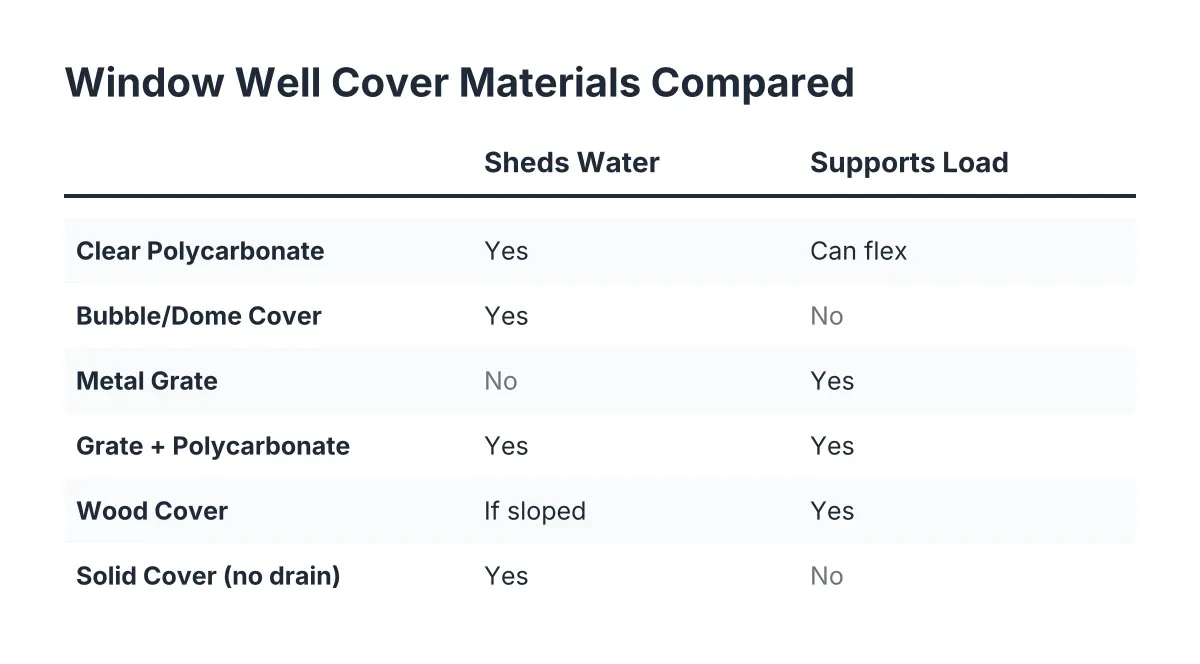
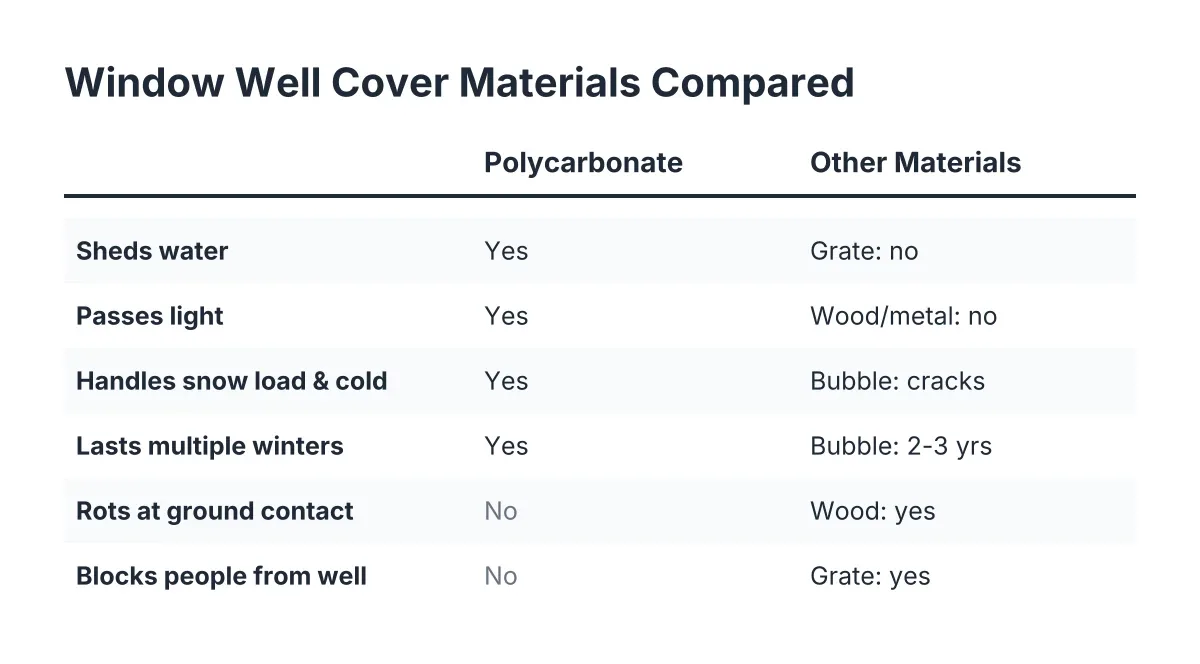
Compare the common options side by side:
- Polycarbonate: Sheds water, passes light, handles snow load and cold, and lasts years. The main trade-off is cost above a basic plastic bubble.
- Wood window well covers: A wooden window well cover is cheap to build and easy to DIY, but it blocks light, absorbs moisture, and rots at ground contact within a few seasons.
- Metal grates: Excellent for safety and load support, and they keep people from stepping into the well. However, a grate alone does nothing to stop rain, snow, or leaves.
- Thin plastic bubbles: Low cost up front, but brittle in cold. In this climate they often crack within two or three winters.
The strongest setup for a Minneapolis basement window well pairs a metal grate with a polycarbonate cover over it. The grate carries the structural load, so a person or a heavy snow drift cannot collapse the cover into the well. Additionally, the polycarbonate layer on top sheds the water and debris. For egress wells serving a bedroom, that combination protects the escape path without blocking it.
Do Polycarbonate Window Well Covers Stop Flooding?
Window well covers stop most flooding that starts inside the well, meaning rain, roof runoff, and snowmelt that falls directly into the opening. They do not stop groundwater that rises from below or water that leaks behind a well that was never sealed to the foundation. A cover is the top half of the fix; drainage and sealing are the bottom half.
Understanding that split saves you money. Suppose a homeowner in South Minneapolis finds two inches of water in the well every spring. If the water shows up during rain and melt, a sloped cover that sheds runoff past the edges of the well solves most of it. If the water seeps in slowly days after the snow is gone, the problem is drainage under the well or a gap where the well liner meets the foundation, and a cover alone will not fix it.
Good covers manage water in three ways. First, they extend past the rim of the well so rain runs off onto the surrounding grade instead of dripping inside. Second, a sloped or domed profile keeps water and snow from pooling on top. Third, a sealant bead along the top back edge, where the cover meets the house, closes the gap where wind-driven rain sneaks in.
That last detail matters more than most DIY guides mention. The right approach is a bead of sealant along the top back edge before fastening, not a caulk line around the entire perimeter. Sealing every edge makes the cover impossible to remove for cleaning, and on an egress well it can interfere with the escape function. The cover over a bedroom egress window must open or lift from the inside without tools.
Sizing a Polycarbonate Cover for Your Well
Correct window well cover sizing starts with three measurements: the width of the well along the house, the projection from the foundation to the outer edge of the well, and the height the well sticks above grade. Measure the outside of the well liner, not the inside, because the cover needs to overlap the rim so water sheds past it.
For example, a standard galvanized well that projects 36 inches from the house needs a cover with more projection than that, since overhang is what keeps rain out. Egress wells are bigger than old block window wells. According to HomeAdvisor, IRC egress code requires a well projecting at least 36 inches from the house with a nine square foot footprint, so egress covers run larger than the standard sizes stacked at a big box store.
This is where the custom vs standard window well covers question gets a real answer. Standard covers fit standard galvanized wells in common widths. If your home has a masonry well, a timber-framed well, an odd width, or a well set against uneven grade, a stock cover leaves gaps at the corners, and gaps defeat the purpose. Measure first. If your dimensions match a stock size within an inch, a standard cover works. If not, a custom-bent polycarbonate cover costs more but actually keeps the water out.
One more sizing note for older Minneapolis homes: many pre-1990 houses have small basement window wells serving glass block or block windows. These narrow wells often need a custom cover because manufacturers size stock covers around modern egress wells. Bring your measurements when you compare options.
DIY Installation vs Hiring a Local Installer
A handy homeowner can install a stock polycarbonate cover on a standard, sound, well-drained window well in an afternoon. The job gets harder, and the stakes get higher, when the well itself needs work, when the cover is custom, or when the window behind it is part of a bedroom egress path.
Here is the honest breakdown for the DIY-minded reader comparing costs. The cover itself is the easy part. The install steps for a straightforward stock cover look like this:
- Clean out the well. Remove leaves, mud, and any debris packed against the window and drainage gravel.
- Check that water drains. Pour a bucket of water in and watch it. If it stands, address drainage before covering.
- Dry-fit the cover and confirm the overlap past the well rim on all open sides.
- Run a bead of exterior sealant along the top back edge where the cover meets the house. Skip the full perimeter.
- Fasten with stainless steel or outdoor-rated screws into the well rim or masonry. Standard indoor fasteners rust and stain the cover within a season.
- On egress wells, confirm the cover lifts or releases from inside without tools.
Where does DIY go wrong? The failures follow a pattern. Homeowners cover a well that has no drainage, which turns the well into a sealed pot that still fills through the soil. They buy a stock cover for a nonstandard well and shim the gaps with foam, which lasts one winter. They seal the entire perimeter and then cannot get the cover off to clear the drain. Or they skip the grade around the well, so surface water still runs downhill into it.
Call a pro instead of DIYing when any of these apply. The well liner has separated from the foundation, which means the seal between well and house needs a continuous bead of polyurethane sealant, and often means the well should come off and be re-set. The well rusted through or collapsed, which is a window well installation job, not a cover job. Water is already getting into the basement, which points to drainage or foundation sealing work. Or the window itself is cracked, foggy, or rotted, in which case basement window replacement should happen before you cover it, not after.
There is a code angle too. In Minneapolis, a bedroom below grade needs a compliant egress window, and per the City of Minneapolis, each bedroom window must be at least 20 inches wide by 24 inches high with nothing blocking it. A cover that bolts down over an egress well can put you on the wrong side of that rule during a rental inspection or a sale. If your basement bedroom is part of the picture, have a local installer confirm the cover keeps the escape path clear.
What a Professional Cover Job Includes
A professional window well cover job should include measurement of each well, a recommendation on stock versus custom sizing, drainage and seal inspection, and installation with outdoor-rated fasteners and correct sealing at the house. Anything less is a delivery, not an install.
Expect the installer to look at more than the cover. A good local installer checks whether the well drains, whether the liner is sealed to the foundation, and whether the grade around the well pushes water toward or away from it. In Minneapolis, they should also account for frost depth and soil movement, because a well that heaves each winter will pop a rigid cover loose no matter how well it was fastened in October.
Cost varies by project, so treat any single number online with caution. For context on the surrounding work, HomeAdvisor puts average window well replacement at $2,200, with most homeowners spending between $1,800 and $3,000, and Angi reports that adding a full egress window and well runs about $3,900 on average. A cover alone costs a fraction of those figures; the point is that catching well problems at the cover stage is far cheaper than replacing a failed well later. A free quote that itemizes the cover, any drainage work, and any sealing work is the fair way to compare.
Turnaround for a cover install is short once the cover is on hand. Stock covers can often go on the same visit. Custom polycarbonate covers need fabrication time after measurement, so plan for a gap between the measure and the install. If you want covers on before the first snow, start in early fall rather than November.
When you compare installers, three questions sort them fast:
- Will you check the well drainage and the seal to the foundation, or only install the cover?
- Is this well a stock size, or does it need a custom cover, and why?
- On an egress well, how does the cover release from inside?
An installer who answers those in plain language, and puts the scope in writing, is worth more than the lowest number on the page. Vague quotes hide the drainage and sealing work that determines whether the cover actually keeps your basement dry.
Getting the Cover Decision Right Before Spring
The order of operations matters more than the brand of cover. Fix the window if it is cracked or foggy, confirm the well drains and seals to the house, then size the cover to overlap the rim, and choose polycarbonate if you want light, snow-load strength, and cold resistance in one piece. In 2026, that combination remains the most durable option for basement window wells in this climate.
For the budget-focused homeowner, the honest math is simple. A stock polycarbonate cover on a sound, standard well is a reasonable weekend project. A custom cover, a leaking well, a rusted liner, or an egress bedroom window is a job where a mistake costs more than the labor you saved. If your situation includes any of those, get a straight answer from a local Minneapolis installer before you buy anything. Measure your wells, note where the water shows up, and ask for a written quote that covers the well condition, not just the plastic on top. That one conversation usually settles the DIY-versus-hire question in ten minutes.
If you need basement egress window installation, Minneapolis Window Pros can help.
Prefer to talk it through? Call (612) 482-9787 — a quick call is usually the fastest way to get a straight answer for your situation.