Basement Window Well Covers with Grates: Safety, Light, and Code Fit in Minneapolis, MN
If a home inspector just flagged your basement windows, or you are getting a basement ready to list, basement window well grate covers are one of the cheaper items on the punch list. They are also one of the most misunderstood. A grate-style cover keeps people and pets from falling into the well, lets light pass through to the basement, and, paired with a clear top cover, keeps spring melt and rain out. This guide walks through when a cover is needed, why a grate setup works well for Minneapolis homes, how covers fit Minnesota egress rules, and what hiring the work out actually looks like in 2026.
Why Window Wells Need Covers in Minneapolis, MN
Minneapolis puts window wells through a hard cycle every year. Snow piles into the well all winter. Then March and April melt everything at once, and the well becomes a bucket sitting against your foundation. If that bucket has no drain, or the drain is clogged with leaves, the water has one place to go: through or around the basement window.
A cover changes that math. Water running off the roofline and siding sheds over the top of the cover and onto the ground beside the well instead of into it. Leaves, mulch, and trash stay out, so the drain at the bottom of the well keeps working. Snow never packs against the glass, so you avoid the slow seep that shows up as a stained sill or a wet carpet corner in a finished basement.
Covers also solve a safety problem. An open well next to a walkway or play area is a fall hazard for kids, pets, and anyone walking the yard at night. For a seller, that open hole is exactly the kind of thing a buyer's inspector photographs and writes up.
Do Window Well Grate Covers Stop Flooding?
Basement window well covers stop most well flooding, because they block the two main water sources: direct rainfall into the well and debris that clogs the well drain. A cover does not fix a failed drain, bad grading, or a well that has pulled away from the foundation, so those problems need their own repairs.
Think of the cover as the first line of defense, not the whole system. A well that drains properly can handle the water that reaches it. The cover's job is to make sure most water never reaches it. On wells with no drain at all, which is common on older Minneapolis homes, a solid cover matters even more, since any water that gets in has nowhere to go.
Fit is what separates a cover that works from one that does not. Covers should be sized larger than the well opening so rain runs off past the edges rather than pooling on top or dripping inside the rim. The top edge should tuck just under the siding line where possible, so water running down the wall continues past the well instead of collecting behind the cover. A bead of caulk or sealant along the back edge where the cover meets the house closes the last gap.
One honest limit: if your basement takes water through the floor or the wall away from the windows, a cover will not help. That is a drainage or waterproofing problem, and it is worth having a pro look at the grading and drain tile before you spend money at the window.
Why Grate-Style Covers Fit Older Minneapolis Homes
A grate is a rigid metal panel that sits across the top of the well. It handles three jobs at once, which is why installers lean on grates for homes where the well sits near a walkway or in a side yard people actually use:
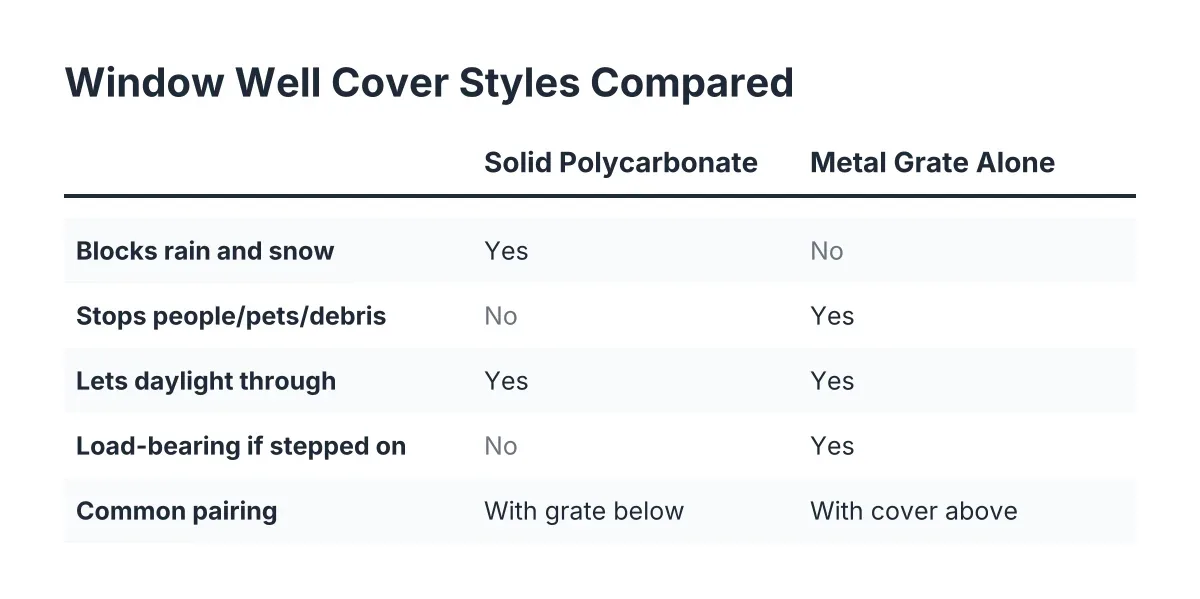
- Load support. A steel or aluminum grate can hold the weight of an adult. If someone steps on the well in the dark or a snowblower pass runs close, the grate takes it. A plastic bubble alone cannot.
- Visibility and light. The open bars let daylight pass through to the basement window. In a finished basement or a basement bedroom, that light is the whole point of the window.
- Escape access. From inside the well, an occupant can push a properly designed grate or hinged grate open and climb out. That matters for egress, which we cover below.
The trade-off is that a grate alone does not stop water or debris. Rain and leaves fall straight through the bars. That is why the setup that works best in Minneapolis is a layered one: the metal grate overlay goes on first for structure and safety, then a clear or frosted polycarbonate cover sits over it to shed water and snow. A frosted polycarbonate top still passes natural light while keeping out debris, water, pets, and snow.
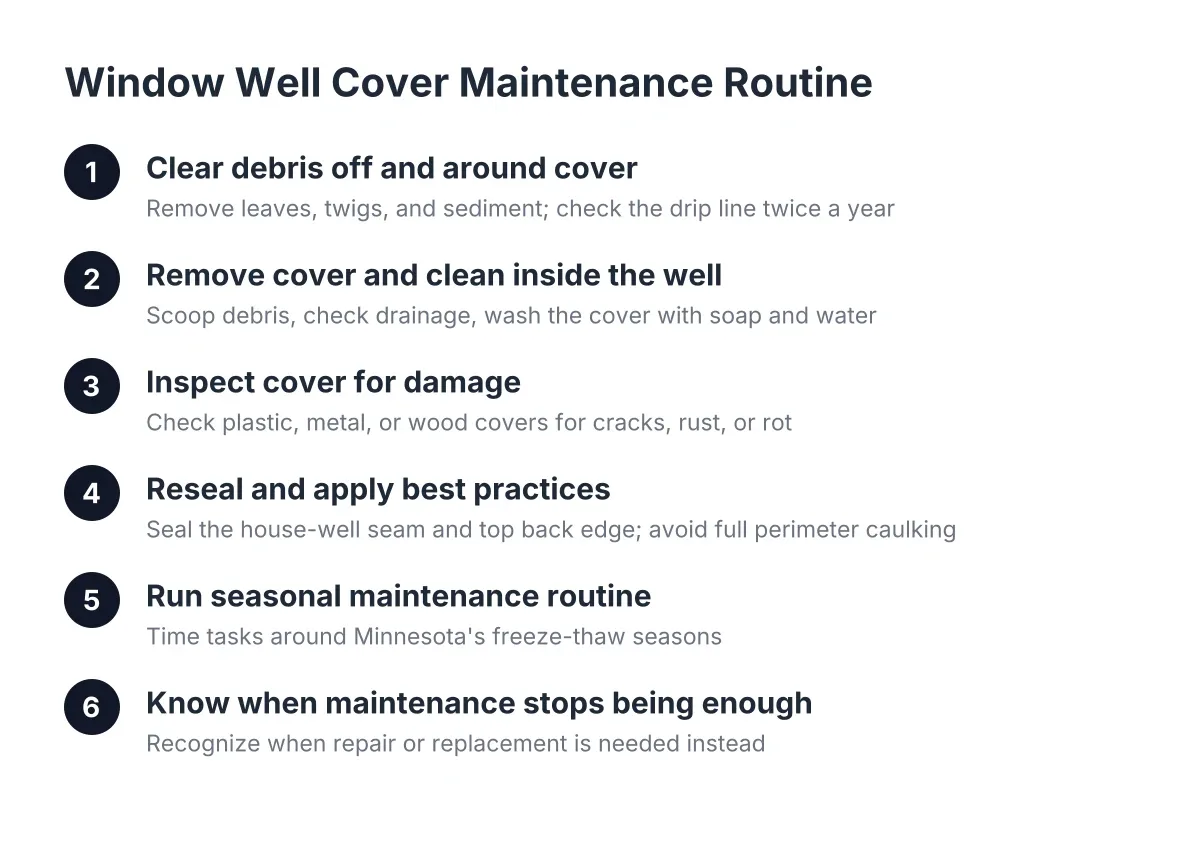
Attachment detail matters here too. A bubble or flat polycarbonate cover should be fastened with a bead of sealant along the top back edge, not sealed around the entire perimeter. That keeps water out where it matters while leaving the cover flexible enough to lift or remove from inside during an emergency.
How Window Well Grate Covers Fit Egress Code
Basement window well covers are legal on egress windows as long as they open from inside without tools, keys, or special knowledge. The cover cannot reduce the required opening or trap someone trying to climb out. Minneapolis enforces bedroom egress requirements, so cover choice matters anywhere a basement room is used, or marketed, as a bedroom.
This is the part that trips up sellers. Suppose a buyer's inspector notes that the basement bedroom has an egress window, but the well is covered with a screwed-down sheet of plywood. That is a write-up, because the occupant cannot get out. A hinged grate or a lift-off polycarbonate cover resolves the same note without touching the window itself.
The underlying numbers set the stage. According to the City of Minneapolis, each bedroom below the fourth floor needs a window at least 20 inches wide by 24 inches high, with nothing blocking it. For the well itself, IRC egress code requires a well that projects at least 36 inches from the house with a nine square foot footprint, and the window needs a minimum net clear opening of 5.7 square feet, according to HomeAdvisor. A cover sits on top of all of that, so it has to respect those clearances, not shrink them.
Older Minneapolis homes often have small steel wells and block windows that were never meant for egress. If your inspection report questions whether the basement window meets the bedroom egress requirement, a cover will not fix that. The fix is an egress window and a code-sized well, and the cover gets sized to the new well. A local installer who does basement window replacement and egress work can tell you in one visit which situation you have.
Custom vs. Standard Window Well Grate Covers, and How Sizing Works
Standard covers fit standard wells. If your home has a common galvanized steel half-round well in a typical size, an off-the-shelf rectangular or round cover from a big-box store will often fit, and it is the cheapest path. You will find basement window well covers at Home Depot, Menards, Lowe's, and on Amazon in the usual sizes.
However, older Minneapolis homes rarely cooperate. Wells on pre-1990 houses come in odd widths, odd projections, and sometimes site-built masonry shapes that no stock cover matches. A stock cover that is close but not right leaves gaps at the corners, and gaps are where water, leaves, and critters get in. Custom covers are measured to the actual well, which is why they cost more and perform better on irregular wells.
Sizing a cover is simple in concept and easy to get wrong in practice:
- Measure the width of the well from outside edge to outside edge.
- Measure the projection from the house wall to the outer rim of the well.
- Add overhang on the exposed sides so runoff sheds past the well, not into it.
- Check the height of anything inside the well, like a window that cranks outward, so the cover clears it.
- Note the siding line; the cover should tuck under or meet it cleanly at the house side.
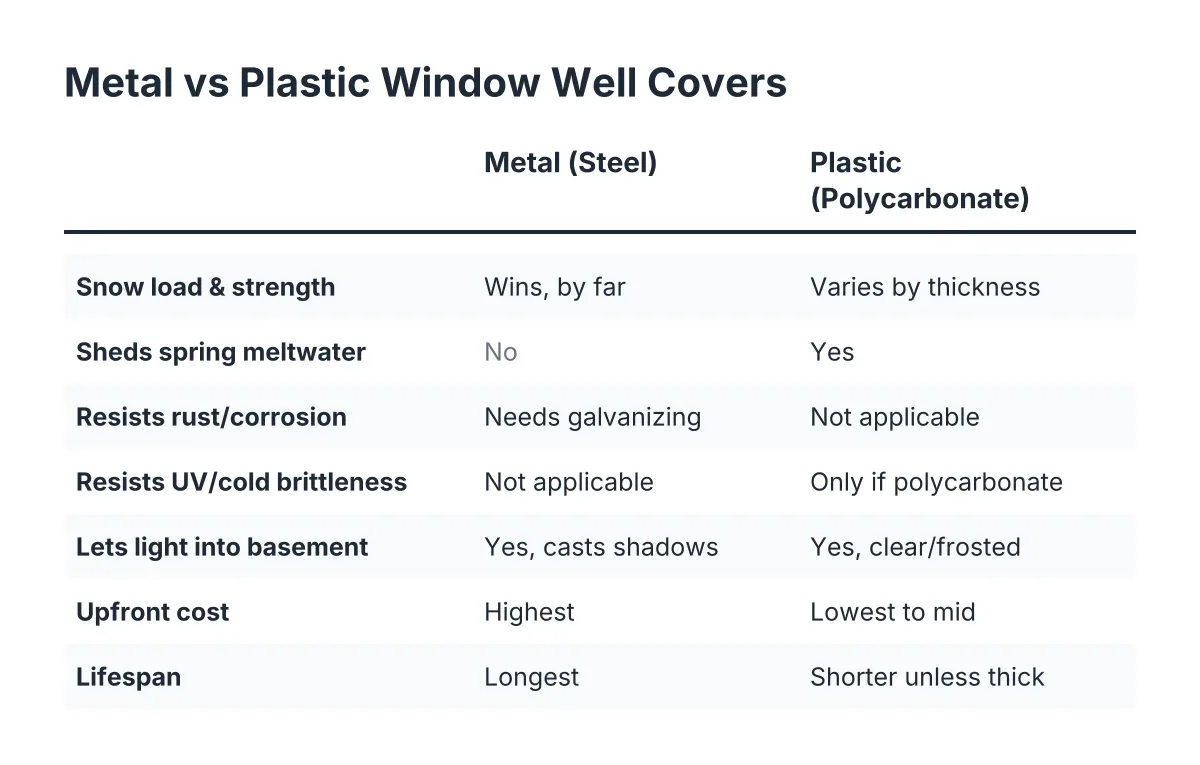
Wood window well covers deserve a quick word, since DIY plans for a wooden window well cover are everywhere online. Wood blocks light completely, rots in ground contact, and gets heavy with snow load. As a temporary measure before listing, it is better than an open well. As the permanent solution on a house you are selling, a grate plus polycarbonate combination reads better to buyers and inspectors.
What Professional Cover and Well Installation Includes
A full-service job covers more than dropping a lid on a hole. When a local installer handles window well cover installation as part of basement window work, the scope usually includes measuring each well, checking the window and well condition, confirming drainage, fitting the grate and cover, and sealing the house-side edge. If the well itself is failing, replacing it is part of the same visit's quote.
That well check matters. A well that has rusted through or pulled away from the foundation lets groundwater in behind the window no matter what cover sits on top. The repair there is to reset or replace the well and seal it to the foundation with a continuous bead of polyurethane sealant from bottom to top. Skipping that step and covering a leaking well just hides the problem until the next heavy rain, which is a bad surprise for you or for your buyer after closing.
On cost, exact numbers depend on the well, the cover type, and whether any window work rides along. For reference points on the bigger jobs, HomeAdvisor reports window well replacement averages $2,200, with most homeowners spending between $1,800 and $3,000. Adding a full egress window and well runs about $3,900 on average, with well installation alone ranging from $500 to $1,500 or more, according to Angi. Covers by themselves sit well below those figures; a written quote for your specific wells is the only number worth negotiating with.
Turnaround is the good news for anyone on a closing timeline. Stock covers install in a single short visit. Custom covers need a measuring visit, a fabrication wait, and an install visit. If a repair addendum has you against a closing date, say so up front; a dated, written quote often satisfies the buyer's side even before the work is finished.
DIY or Hire It Out Before You List
Plenty of homeowners can handle a stock cover themselves. If your wells are standard sizes, the windows are sound, and the inspection note just says "open window wells," buying covers and setting them with a bead of sealant along the back edge is a reasonable Saturday project.
Call a pro instead when any of these apply:
- The well is rusted, leaning, or separated from the foundation.
- Water has already come in through or around the basement window.
- The basement room is a bedroom and the window may not meet egress size.
- The wells are odd shapes or sizes and stock covers leave gaps.
- You are mid-sale and need documented, workmanlike repairs an inspector will accept.
For sellers, that last point is the real one. A buyer's inspector who finds a hardware-store cover zip-tied over a failing well will write it up again. A documented repair from a local installer closes the item and takes the leverage off the table.
There is also a seasonal angle. Frost in Minneapolis soil complicates any digging, so well replacement and egress excavation are easier to schedule between spring thaw and early winter. Cover-only work happens year-round, but if your project might grow into well or window replacement, earlier in the season gives you more room before a closing date.
How to Choose an Installer in Minneapolis, MN
You do not need a long vetting process for this trade, but three questions separate a solid local installer from a phone number on a thin website:
- Will you look at the well and the drainage, not just the opening? A cover quote that ignores a failing well or a clogged drain is an incomplete quote.
- How will the cover work with egress? Anyone quoting a cover for a basement bedroom should raise the escape question before you do.
- Is the quote written, itemized, and tied to my actual measurements? Phone estimates from a script tend to move once someone sees the house. A measured quote holds.
A fair quote names the cover type and material, states whether a grate is included, covers sealing at the house side, and flags any well or window problems found during the visit. If a basement window replacement or an egress upgrade is actually what the inspection calls for, you want one company able to quote both so you are not stitching two contractors together on a deadline.
For Minneapolis homeowners, especially anyone staring at an inspection report with a closing date attached, the path is short: get the wells measured, get a written quote, and pick the cover style that matches how the room is used. Window well grate covers are a small line item that closes an inspection note, protects a finished basement from spring melt, and keeps a sale moving. If you want a straight answer on your specific wells, windows, or an egress question, reach out for a free quote; measuring a few wells and putting numbers on paper is a quick visit, and it gives you something concrete to hand the buyer's side.
Prefer to talk it through? Call (612) 482-9787 — a quick call is usually the fastest way to get a straight answer for your situation.