Metal vs. Plastic Window Well Covers: Which Lasts Longer in Minnesota
If your home inspector flagged an open or clogged window well, you are probably weighing a metal or plastic window well cover right now. Both keep out leaves, snow, and rain. Both can pass a buyer's walkthrough. But they age differently in Minnesota, and the wrong choice can put you right back where you started: standing water in the well and a wet mark on the basement wall a buyer will notice.
This article compares the two head to head for Minneapolis homes: how each handles snow load, freeze-thaw, spring melt, and the short timeline of a home sale. By the end, you should know which one fits your well, your budget, and your closing date.
Why an Uncovered Window Well Becomes a Sale Problem
An open window well collects everything: leaves in October, snow in January, and melting slush in March. The debris clogs the drain gravel at the bottom. Then spring rain fills the well like a bucket, and the water finds the window seal.
That is usually the moment a homeowner starts pricing covers. Say a homeowner in South Minneapolis lists in April. The buyer's inspector finds an inch of standing water in the well and a water stain under the basement window. Now the repair addendum asks for "correction of water intrusion," which sounds expensive and vague. In that scenario, a working cover, clean gravel, and proper grading might have kept the whole item off the report.
A cover is not a fix for every problem. If the well itself is rusted through, pulling away from the foundation, or has no drainage below it, a cover only hides the issue. That is a window well installation or replacement question, and it is worth a professional look before you spend money on a lid.
Metal vs Plastic Covers: What to Choose
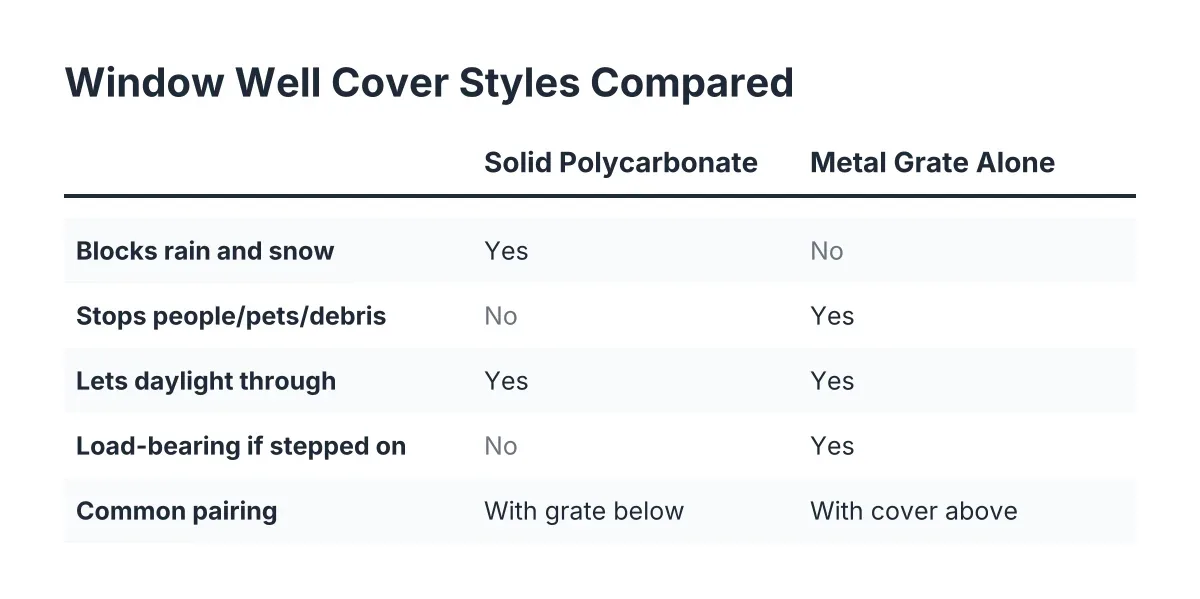
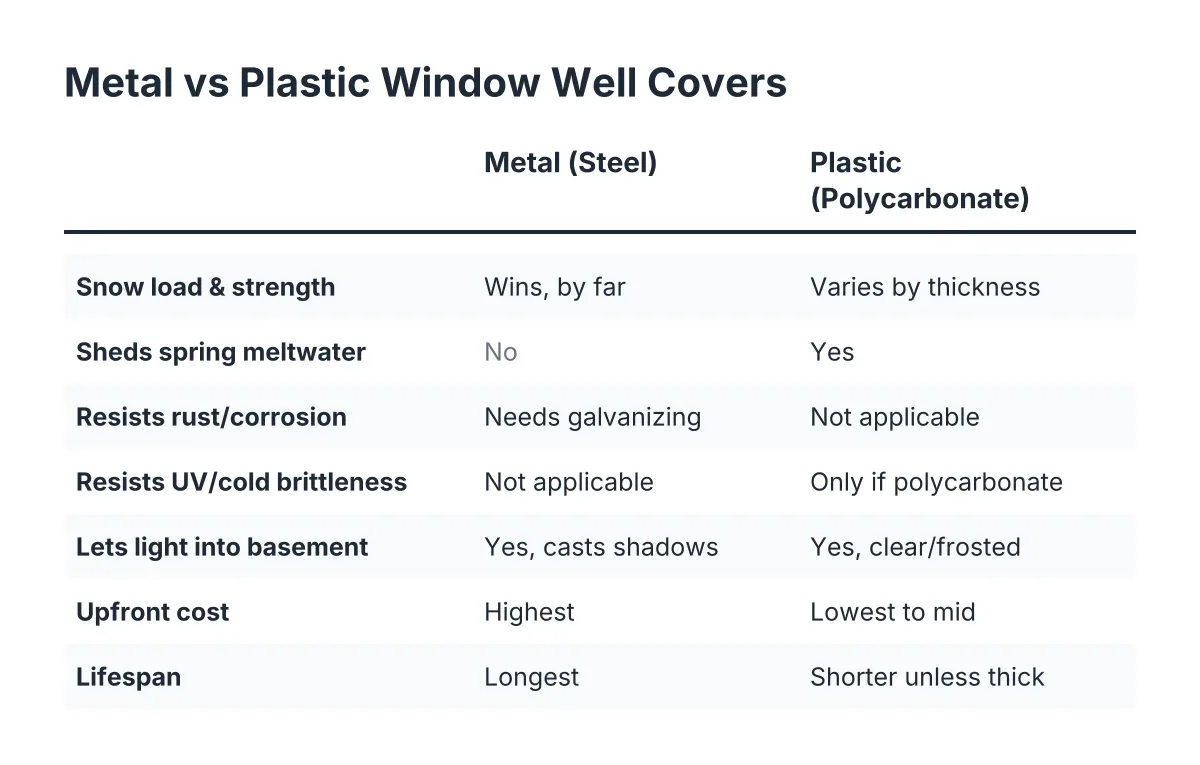
The short version: metal covers, usually steel grates, last longer and carry more weight, but they let rain and snow fall straight into the well. Plastic covers, usually clear or frosted polycarbonate bubbles or flat lids, shed water and let in light, but cheap versions crack in deep cold. Many Minneapolis homes end up with both, a grate for strength with a clear cover on top.
Here is how the two stack up on the things that matter in Minnesota.
Snow load and strength
Steel wins on strength, and it is not close. A welded steel grate can hold the weight of a person, a dog, or three feet of compacted snow sliding off the roof. That matters on the north side of a house where snow piles up from November to March.
Plastic covers vary widely. A thin vacuum-formed bubble from a big-box store can crack under heavy snow or a misplaced boot. Thicker polycarbonate holds up far better and flexes instead of shattering. If kids or pets cross the well, or the well sits under a roof valley that dumps snow, you want either steel or heavy polycarbonate, not a thin bubble.
Water: the spring melt test
This is where the comparison flips. A steel grate is an open grid. Rain, snowmelt, and drips off the siding fall straight through into the well. If your well drains fast, that is fine. If it does not, a grate alone does nothing to stop spring flooding.
A solid plastic cover sheds water instead. Good covers extend past the edge of the well, so runoff rolls onto the ground rather than pooling inside. As a general rule, if there is no working drain under the well, a solid cover is the safer choice, because an open grate lets every storm refill the bucket. For homeowners searching "do window well covers stop flooding," the honest answer is: solid covers help a lot, open grates by themselves do not.
Cold, sun, and how each material ages
Minnesota is hard on both materials, just in different ways. Steel rusts. A painted or powder-coated grate holds up for years, but scratches and standing slush eventually start corrosion, especially where the grate meets the well. Galvanized steel resists this longer, which is one reason galvanized wells and hardware are standard here.
Plastic gets brittle. UV exposure and repeated freeze-thaw cycles turn cheap acrylic bubbles yellow and fragile within a few seasons. Polycarbonate handles cold and sun much better and is the plastic worth paying for in this climate. Either way, outdoor-rated or stainless fasteners matter; a strong cover held down by rusted screws stops being a strong cover.
Light into the basement
If the window serves a finished basement or a bedroom, light matters. A clear or frosted plastic cover keeps daylight coming through. A steel grate alone also passes light, though it casts shadows. Additionally, a solid metal or wood lid blocks light entirely, which can make a finished basement room feel like a storage closet.
One more note for anyone with a bedroom down there: whatever cover you choose cannot block the escape path. Minneapolis code requires each bedroom below the fourth floor to have a window at least 20 inches wide by 24 inches high with nothing blocking it, according to the City of Minneapolis. A bolted-down cover over a bedroom egress window can turn a code-compliant window into a violation. Covers over egress wells need to open or lift from inside without tools.
Cost and lifespan
Pricing varies by well size, cover style, and whether the cover is standard or custom, so treat any online number as a rough guide. As a general pattern, thin plastic bubbles cost the least and last the shortest. Heavy polycarbonate costs more and lasts many seasons. Custom steel grates cost the most up front and can outlast the window itself with occasional paint touch-ups.
For context on the bigger picture: window well replacement costs an average of $2,200, with most homeowners spending between $1,800 and $3,000, according to HomeAdvisor. A cover is a small fraction of that. If the well itself is failing, though, the cover budget belongs in the replacement conversation, not on top of a well that is coming apart.
What About Wood Window Well Covers?
Wood covers exist, usually as homemade plywood lids. They block debris and water for a season or two, which is why some sellers reach for them before listing. However, plywood soaks up moisture, delaminates, and rots against damp steel or concrete. It also blocks all light and can raise inspector questions about egress if it covers a bedroom window.
If you need a fast, cheap stopgap before a showing, wood can bridge a few weeks. As a lasting answer in a metal vs plastic window well cover decision, it loses to both.
Sizing and Fit: Where Most Covers Fail
Most cover failures are fit failures, not material failures. A cover that sits flush with the well edge lets rain run down the siding and drop behind it, straight into the well. A few fit rules make either material work better:
- The cover should extend past the well opening so runoff sheds onto the ground, not into the well.
- The top edge should tuck just under the overhanging siding, so water running down the wall drains past the cover instead of collecting behind it.
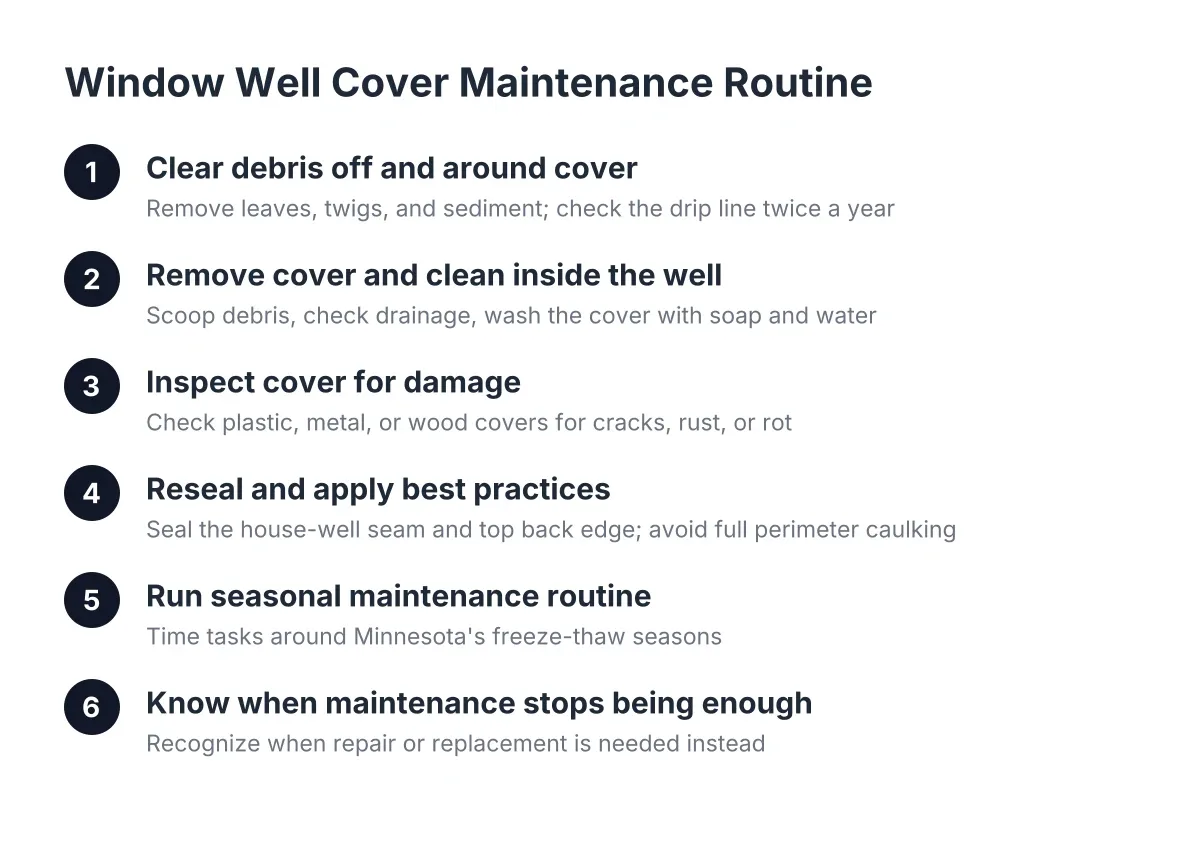
- A bead of sealant along the top back edge before fastening keeps water out while still letting you remove the cover later. Sealing the entire perimeter makes removal a fight.
- Use a few outdoor-rated screws, not a dozen. Covers come off for cleaning and window work, and over-fastened covers get pried off and bent.
Standard covers fit standard half-round galvanized wells, which most pre-1990 Minneapolis homes have. Older masonry wells, oversized egress wells, and odd rectangles usually need custom covers. If you cannot find a stock cover that overlaps your well on all sides, custom is not an upsell; it is the only version that will keep water out.
So Which Lasts Longer, Metal or Plastic?
For pure lifespan in Minnesota, a coated or galvanized steel grate outlasts any plastic cover; the trade-off is that a grate alone does not stop water. Thick polycarbonate is the longest-lasting plastic, handling freeze-thaw and UV far better than cheap acrylic bubbles, and it actually sheds rain and snowmelt. Many wells here get both: steel below for strength, polycarbonate above for water and light.
That layered setup answers the metal vs plastic window well cover question for a lot of Minneapolis basements. The grate carries snow and foot traffic. The clear cover keeps the well dry and bright. Neither one alone does both jobs.
How to Choose for Your House and Timeline
Work through it in this order:
- Check the well first. Rust-through, separation from the foundation, or no drainage means the well needs attention before any cover goes on.
- Ask what the well drains into. No drain below means a solid cover, plastic or layered, not a bare grate.
- Ask what is above it. Roof valleys, heavy snow slide, kids, or pets point toward steel or thick polycarbonate.
- Ask what is behind the window. A bedroom means the cover must lift from inside without tools; a finished basement room means light through the cover is worth paying for.
- Measure before you buy. The cover must overlap the well on every side, or water goes right around it.
If you are fixing an inspection item before closing, get the well and window looked at together rather than buying a cover blind. Basement window replacement, window well installation, and covers interact, and a local installer who knows Minneapolis frost depth and well styles can tell you in one visit whether you need a lid, a new well, or both. Quotes for that kind of look are typically free, and a documented quote is exactly what a repair addendum negotiation needs.
If you need basement egress window installation, Minneapolis Window Pros can help.
Prefer to talk it through? Call (612) 482-9787 — a quick call is usually the fastest way to get a straight answer for your situation.