Window Well Covers Materials: Which Type Fits Minneapolis Homes and Budgets
If a home inspector just flagged your basement windows, or you are prepping a house for sale, the question of window well cover materials moves from "someday" to "this week." A missing or cracked cover shows up on inspection reports, and an open well that collects water shows up as stains on the basement wall. The good news: covers are one of the cheaper items to fix before closing. The harder part is picking the right material for the well you have, because a cover that fits wrong or sags under snow will not solve the flooding problem Minneapolis basements deal with every spring melt.
This list walks through the main cover materials and styles, what each one does well, where each one fails, and how to decide without overpaying. If your inspection issue is bigger than a cover, say the well itself is rusted out or the window does not meet the bedroom egress requirement, we cover that too.
1. Clear Polycarbonate: The Default Choice for Most Wells
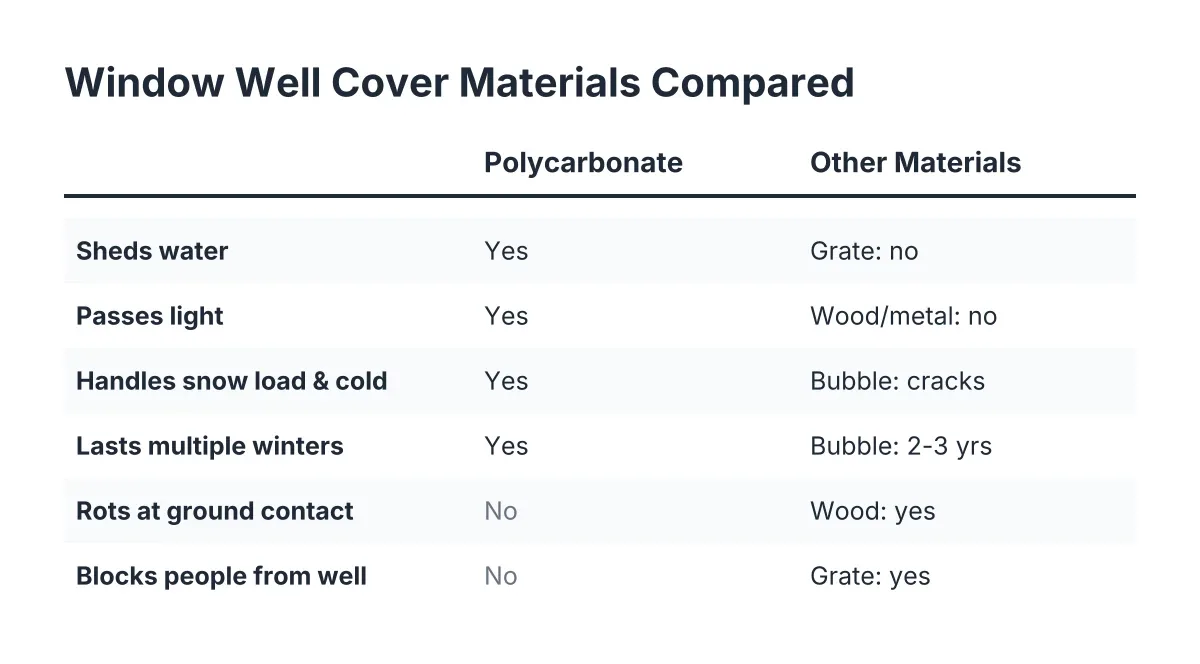
Polycarbonate window well covers are the standard answer for a reason. The material is a rigid, impact-resistant plastic that sheds rain and snow, lets daylight through to the basement, and holds up to Minnesota freeze-thaw cycles better than cheaper plastics. For a homeowner fixing an inspection item before listing, a clear polycarbonate cover looks intentional and well-maintained, not like a patch job.
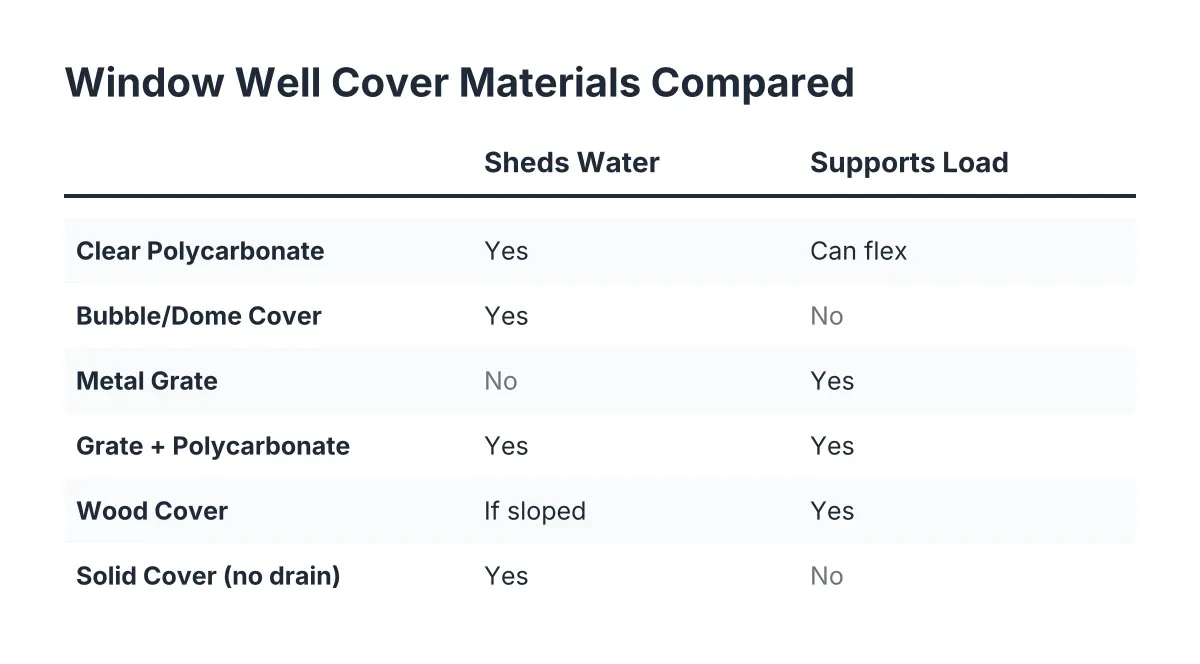
The trade-off is that flat polycarbonate sheets can flex under a heavy snow load if the span is wide and unsupported. On larger egress wells, look for covers with a metal support frame or plan to add a grate underneath. Also confirm any cover on an egress well can be opened or pushed off from inside without tools; code compliance means the escape route stays usable.
2. Bubble and Dome Covers: Best for Shedding Spring Meltwater
Bubble covers, sometimes called dome covers, are formed plastic window well covers that arch over the well like a skylight. That curve matters in Minneapolis. Snow slides off instead of piling up, and meltwater runs over the edges rather than pooling on top and seeping down into the well. If your basement takes on water every March, a dome shape solves more of that problem than a flat sheet does.
However, domes work best on standard semicircular metal wells. They fit poorly on square timber wells or oversized custom wells. Installation matters too: run a bead of sealant along the top back edge where the cover meets the house before fastening it, rather than caulking the whole perimeter. That keeps water out at the critical joint while leaving the cover flexible enough to remove for cleaning or escape.
3. Metal Grates: Load Support and Safety, Not Water Protection
A metal grate sits flat over the well opening and carries weight. If your well sits along a walkway, near a play area, or anywhere someone could step on it, a grate protects people and pets from a fall into the well. Grates also protect the window itself; a well full of loose river rock or a dropped tool can crack basement glass, so a grate earns its place on wells that see foot traffic.
The catch is obvious: a grate is full of holes. Rain, leaves, and blown snow pass straight through. On its own, a grate does nothing for the spring flooding problem. Think of it as the structural layer, not the weather layer.
4. Grate Plus Polycarbonate: The Combination That Handles Minnesota Weather
Pairing a metal grate with a frosted or clear polycarbonate sheet on top gives you both jobs in one assembly. The grate carries snow load and foot traffic; the polycarbonate sheds water and debris while still letting light reach a finished basement. For homes where the well sits under a roof valley or downspout, this combination handles the water volume a single flat sheet cannot.
For example, suppose a homeowner in South Minneapolis has an egress well on the north side that fills with snow all winter, then floods the well during the first warm week of April. A dome will not fit their square galvanized well. In that scenario, a grate overlay with a fitted polycarbonate cover over it stops the meltwater at the top of the well instead of asking the drain to handle all of it.
5. Wood Window Well Covers and Materials: Cheap to Build, Costly to Maintain
Wooden window well covers appeal to handy sellers because you can build one from framing lumber and a sheet of polycarbonate or heavy plastic for less than most manufactured covers. Built well, with a slight slope so water runs off, a wood frame cover works. It also fits odd-sized timber wells that no standard cover matches.
Still, wood in ground contact rots, and a heavy solid-wood lid blocks all light to the basement. If the well serves a bedroom egress window, a heavy wooden lid can also make the escape route unusable, which trades one inspection problem for a worse one. For a pre-sale fix, a manufactured cover usually reads better to a buyer's inspector than a homemade lid.
6. Solid Covers for Wells Without Drains
Not every window well has a drain at the bottom. If yours does not, that changes the material decision. A vented grate or loose-fitting cover lets water in with nowhere for it to go, so the well slowly fills and pushes water against the window. On drainless wells, use a solid cover that overhangs the well edges so rain runs off onto the surrounding grade instead of into the pit.
You can check for a drain yourself: pull back the gravel at the bottom of the well and look for a pipe opening. If you find standing water or saturated soil instead, a solid cover is the short-term fix, and a well drain or regrade is the longer-term one. This is a case where a local installer who knows Minneapolis clay soil and frost depth is worth a call, because drainage fixes vary house to house.
7. Sizing and Selection of Window Well Cover Materials: Why the Cover Should Be Bigger Than the Well
Window well cover sizing trips up more homeowners than material choice does. A cover should extend past the well edges on all open sides, typically by an inch or two, so rain hits the cover and runs off onto the ground beyond the well. A cover cut flush to the well rim lets water track along the edge and drip straight in, which defeats the purpose.
Measure three things before ordering:
- Width of the well along the house wall
- Projection, meaning how far the well sticks out from the foundation
- Height of the well above grade, since some covers need clearance over the rim
Also check the cover's relationship to your siding. The top of the well and cover should sit just under the overhanging siding so water running down the wall drains past the cover, not behind it.
8. Custom vs. Standard Covers: When Off-the-Shelf Stops Working
Standard covers fit standard wells, which in Minneapolis usually means semicircular galvanized steel wells in a handful of common widths. If that describes your house, a stock polycarbonate or dome cover ordered to your measurements will do the job at the lowest cost. Egress wells are where standard sizing breaks down. Code-sized wells are big; according to HomeAdvisor, IRC egress rules call for a well projecting at least 36 inches from the house with a nine square foot footprint, and few bargain covers span that.
Custom covers cost more but fit timber wells, oversized egress wells, and wells with ladders or steps. If you are selling, weigh the timeline: a custom cover can take weeks to fabricate, while a standard cover ships fast. With a closing date set, the standard cover that fits adequately today may beat the perfect cover that arrives after the walkthrough.
9. Installation Details That Decide Whether a Cover Stops Flooding
Do window well covers stop flooding? A properly sized, properly sealed cover stops most water from entering the well from above, which is where the bulk of spring flood water comes from. It cannot fix groundwater rising from below or a clogged well drain, so a cover is one layer of the system, not the whole system.
A few installation habits separate covers that work from covers that leak:
- Seal the joint where the cover meets the house wall; that seam takes the most water.
- Do not overdo the screws. You may need to remove the cover for cleaning or emergency egress, and a dozen fasteners makes that a project.
- Keep the cover clear of leaves and snow buildup so weight does not crack the plastic.
- On egress wells, confirm the cover releases from inside without tools. That is a code compliance issue, not a preference.
If the well itself is rusted, pulling away from the foundation, or too small for the window, no cover material fixes that. Well replacement runs about $2,200 on average, with most homeowners spending between $1,800 and $3,000, according to HomeAdvisor. That is a different project than a cover, and worth a professional look before you commit either way.
10. Sellers: Match the Fix to the Inspection Item
If a buyer's inspector flagged the basement windows, read the report language carefully before buying anything. "Window well cover missing or damaged" is a cover purchase you can handle in a weekend. "Bedroom window does not meet egress requirements" is a different job entirely; Minneapolis code requires each bedroom window below the fourth floor to be at least 20 inches wide by 24 inches high with nothing blocking it, according to the City of Minneapolis. A cover will not close that gap.
Therefore, get the scope right first, then pick materials. As of 2026, a straightforward cover swap resolves many inspection notes without touching the closing timeline. When the report points to the well or the window itself, get a written quote from a local basement window installation contractor so you have a documented number to bring to the negotiation instead of a guess. Quotes for this kind of work are typically free, and pricing varies by project, so the paper trail costs you nothing.
The Short Version
Match the material to the well and the problem. Polycarbonate window well covers or domes for water, grates for load and safety, the grate-plus-polycarbonate combination for wells that face both, solid covers for drainless wells, and custom fabrication only when standard sizes fail. Size every cover larger than the well opening, seal the house-side seam, and keep egress wells escapable from inside. For a pre-sale fix on a tight timeline, the right basement window well covers choice is usually the standard one that fits, installed correctly, with documentation you can hand to the buyer.
If you need basement egress window installation, Minneapolis Window Pros can help.
Prefer to talk it through? Call (612) 482-9787 — a quick call is usually the fastest way to get a straight answer for your situation.