Do Window Well Covers Keep Water Out of Minneapolis Basements?
Do window well covers actually stop water from getting into your basement? Mostly yes, if you pick the right style for your well and install it so rain sheds past the edges instead of pooling. Window well covers with waterproofing quality are important when spring melt starts finding its way into window wells, so you can decide whether a cover is worth it and which type fits your well and budget.
Do window well covers stop basement flooding?
Window well covers stop most of the water that would otherwise land in the well: rain, roof runoff, and snowmelt. A solid cover sized larger than the well opening sheds water over the edges instead of letting it pool inside. However, a cover cannot stop groundwater that rises from below, so a well with poor drainage can still flood from underneath.
Think of it this way. Water gets into a window well from two directions: the top and the bottom. A cover handles the top. Drainage gravel, a drain tile connection, or at minimum a well that is not packed with debris handles the bottom. If your basement window leaks every March, you probably need both working.
In Minneapolis, the spring problem is usually snow. A well that fills with snow all winter turns into a bathtub during the first warm week. A cover that keeps snow out in the first place does more for you than any amount of bailing in April.
Do window wells need covers at all?
Not every window well needs a cover, but most wells in Minnesota benefit from one. If your well has a working drain, sits under a wide roof overhang, and stays clear of leaves and snow, you may get by without one. If the well collects debris, fills with snow, or has no drain underneath, a cover is the cheapest flood protection you can buy for that opening.
Here is a quick way to decide:
- No drain under the well: use a solid cover, because any water that gets in has nowhere to go.
- Well fills with leaves or snow: a cover pays for itself in avoided cleanouts and melt water.
- Egress well outside a basement bedroom: yes, but it must open or lift from inside without tools so the escape path stays usable.
- Small well under a deep overhang that stays dry: a cover is optional; a grate for safety may still make sense.
One caution for egress wells. Minneapolis code requires each bedroom below the fourth floor to have a window at least 20 inches wide by 24 inches high, with nothing blocking it, according to the City of Minneapolis. A screwed-down or snow-buried cover that nobody can lift from inside defeats the point of the egress window. Choose a hinged or easily removable style for any bedroom well.
Window well covers and waterproofing: which styles actually keep rain and moisture out?
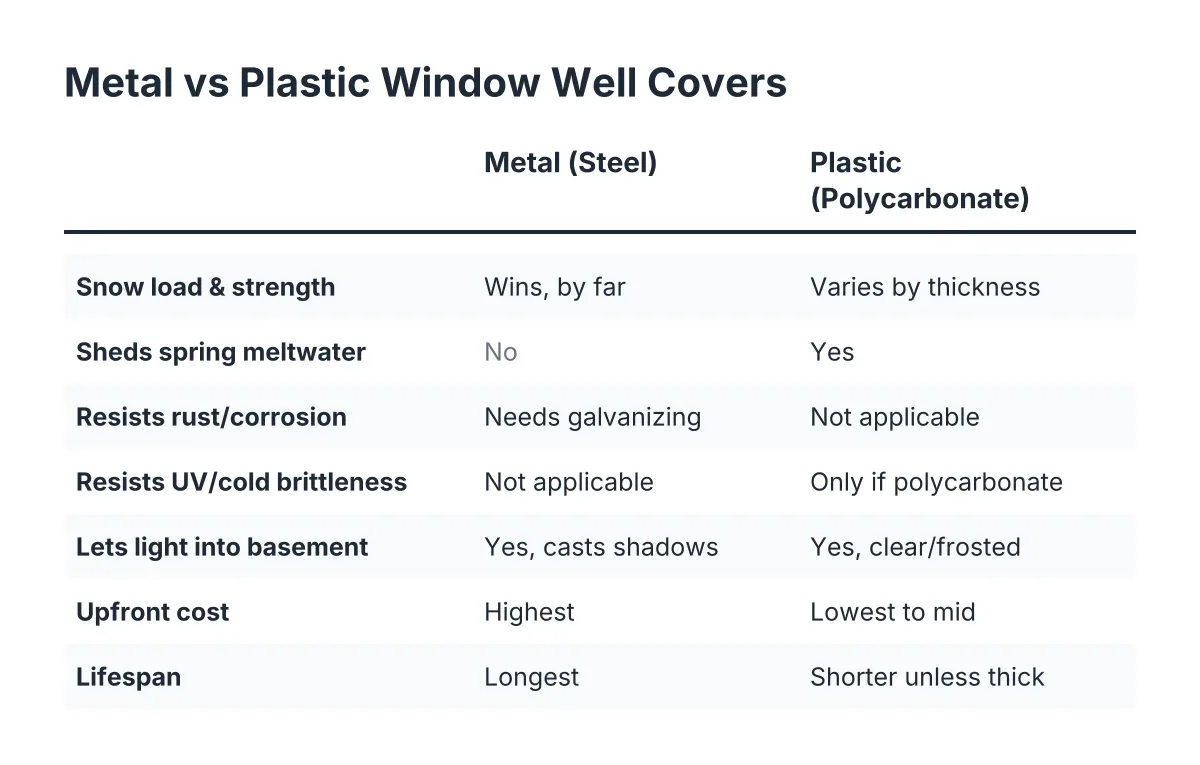
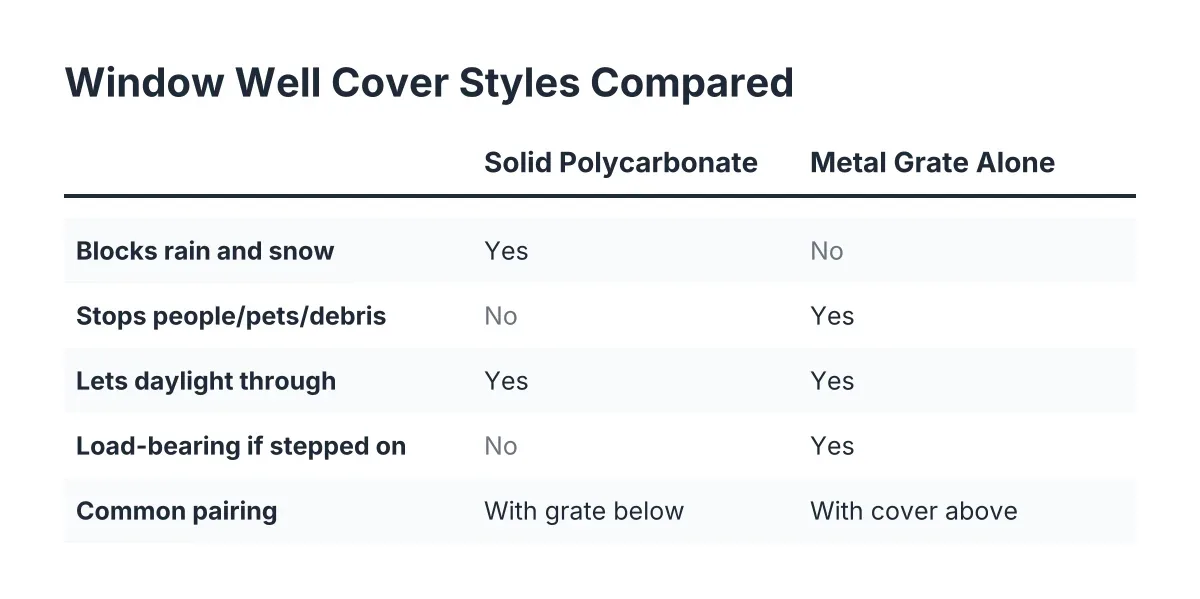
Solid polycarbonate covers with waterproofing properties keep rain out best because water cannot pass through them at all. Sloped or domed shapes shed water faster than flat ones. Metal grates alone do not keep rain out; they stop people, pets, and large debris, but water and snow fall straight through. Many homeowners pair a grate for strength with a clear cover on top for weather.
A frosted or clear polycarbonate cover over a grate is a common setup on egress wells. The grate carries the load if someone steps on it. The cover sheds rain and snow while still letting daylight reach the basement window, which matters if you spent money on an egress window partly for the light.
Mesh covers sit in the middle. They block leaves and animals but let rain through, so they only make sense on wells with solid drainage. For the top-and-bottom comparison of materials, flat versus domed shapes, and how each handles Minnesota freeze-thaw, that is a separate decision from whether you need a cover at all.
How do window well covers attach, and do they need to be fastened?
Most window well covers attach with brackets or clips to the well liner, or with fasteners into the siding or rim area above the window. Lightweight plastic covers should be fastened; otherwise a strong gust lifts them into the neighbor's yard. Heavy metal grates often sit in place by weight alone.
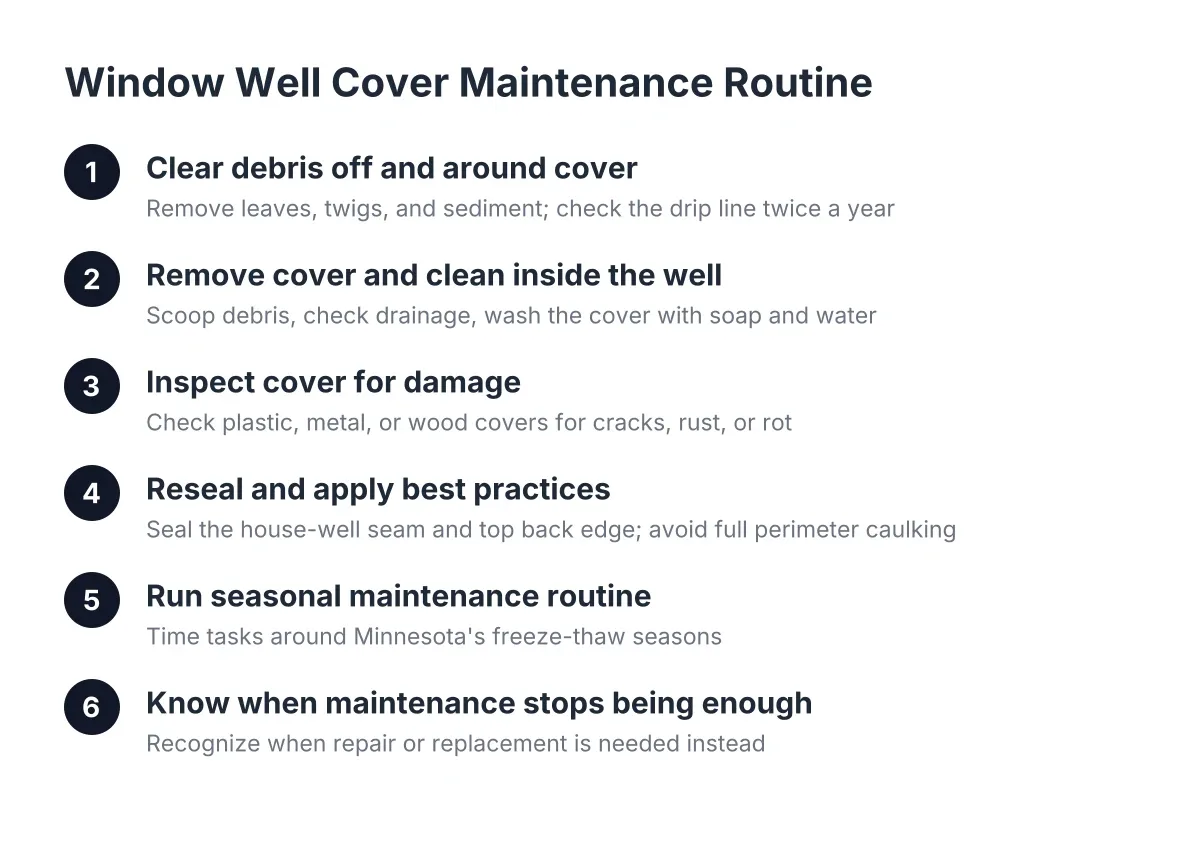
Attachment matters for water too. A smart detail is running a bead of sealant along the top back edge of the cover before fastening it, rather than caulking the whole perimeter. That keeps water from sneaking behind the cover at the house side while leaving the cover flexible enough to remove. Full-perimeter caulk traps you into cutting it loose every time you need access.
The well itself should also be sealed where it meets the foundation. A continuous bead of polyurethane sealant where the well liner meets the wall keeps groundwater and dirt from working in behind the well. A cover over a well that leaks at the foundation seam only solves half the problem, and waterproofing at the seam is essential before installing window well covers.
Can I install a window well cover myself?
Yes, a standard-size cover on a standard well is a reasonable DIY job for a handy homeowner. You measure the well, order or buy the cover, position it so rain sheds past the edges, and fasten it. The common mistakes are buying a cover sized to the opening instead of larger than it, and skipping the back-edge seal so water runs down the siding and straight behind the cover.
Sizing is where DIY jobs go sideways. Covers should extend past the well on all open sides so runoff drips onto the ground, not into the well. Measure the widest point of the well, the projection from the house, and check whether your siding overhangs the well. A cover tucked just under the overhanging siding lets water running down the wall continue past instead of collecting behind it.
Where it stops being a weekend project is when the well itself is the problem. A rusted-through galvanized well, a well with no drainage, or a well that sits too low against the siding needs correction before a cover will help. Suppose a homeowner in South Minneapolis with a 1960s rambler finds the steel well rusted at the base and water staining below the basement window. In that scenario, a cover alone is a bandage; the fix is window well installation done right, with drainage and a sealed connection to the foundation, and that is worth a professional look. For reference, window well replacement averages $2,200, with most homeowners spending between $1,800 and $3,000, according to HomeAdvisor.
Do window well covers help with insulation and heat loss?
Window well covers add a modest insulation benefit by trapping an air pocket over the basement window and blocking wind. They are not a substitute for a decent basement window, but they cut the draft that an old single-pane or cracked glass block window pours into a finished basement. If the window behind the well is foggy, cracked, or original to a pre-1990 house, basement window replacement does far more for comfort than any cover will.
The order of operations matters here. If you are planning a basement finishing project in 2026, sort the windows first: confirm the bedroom egress requirement is met, replace failing block windows or old units, fix the wells, then cover them. Covering a failing window just hides the problem behind plastic.
Custom or standard window well covers and waterproofing choices
Standard covers fit standard wells, which covers most semicircular metal wells on post-war Minneapolis homes. If your well is an unusual size, a timber or wooden window well, or a large rectangular egress well, a custom cover is the better buy because gaps are where water, leaves, and critters get in. A standard cover that leaves a two-inch gap at the siding did not save you money; it just moved the leak.
Measure before you shop. Width at the widest point, projection from the house, and height above grade tell you whether an off-the-shelf cover will seat properly. Egress wells are big by design; IRC egress code requires a well projecting at least 36 inches from the house with a nine-square-foot footprint, according to HomeAdvisor, so egress covers are often custom or semi-custom by nature.
The short answer
Covers work. They keep rain, snow, leaves, and pets out of the well, and in a Minneapolis spring that is most of the battle. They do not fix bad drainage, a rusted well, or a failing basement window, and on an egress well they must stay openable from inside. Decide based on what your well actually needs: a cover, a drainage fix, or both. Pricing varies by well size and cover type, so a free quote from a local installer is the fastest way to compare the DIY number against the done-for-you number.
If you need basement egress window installation, Minneapolis Window Pros can help.
Prefer to talk it through? Call (612) 482-9787 — a quick call is usually the fastest way to get a straight answer for your situation.