Window Leaking Into Wall From the Top? How to Triage It Fast in 6 Steps
Water dripping from the top of a basement window frame is one of the more confusing leaks a homeowner can face. The water shows up at the window, but the source is almost never the glass itself. If you have a window leaking into wall cavities above or beside the frame, you need to find the real entry point fast, because water inside a wall rots framing and feeds mold long before you see damage. This guide walks you through a quick triage so you know within an hour whether you are looking at a tube-of-caulk fix or a replacement project, and who to call for a leaking window if it turns out to be the bigger one.
Here is the short version. Water at the top of a basement window usually comes from one of four places: a flooded window well, a failed seal or gap above the frame, water traveling down inside the wall from a problem higher up, or grading that pushes rainwater at the house. Each one has a different fix and a different price tag. Work through the steps in order and you will know which one you have.
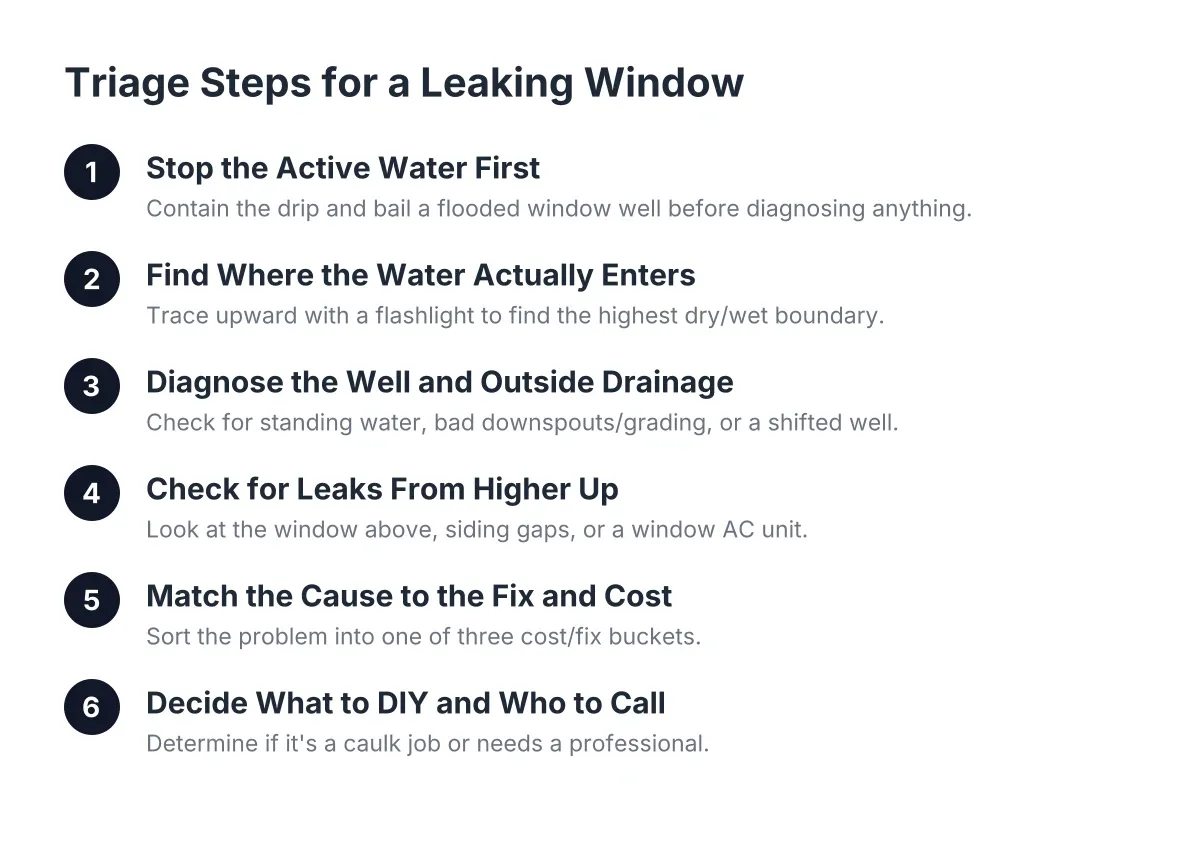
Step 1: Stop the Active Water First
Deal with the water before you diagnose anything. If rain is coming in right now, your job is containment, not root cause.
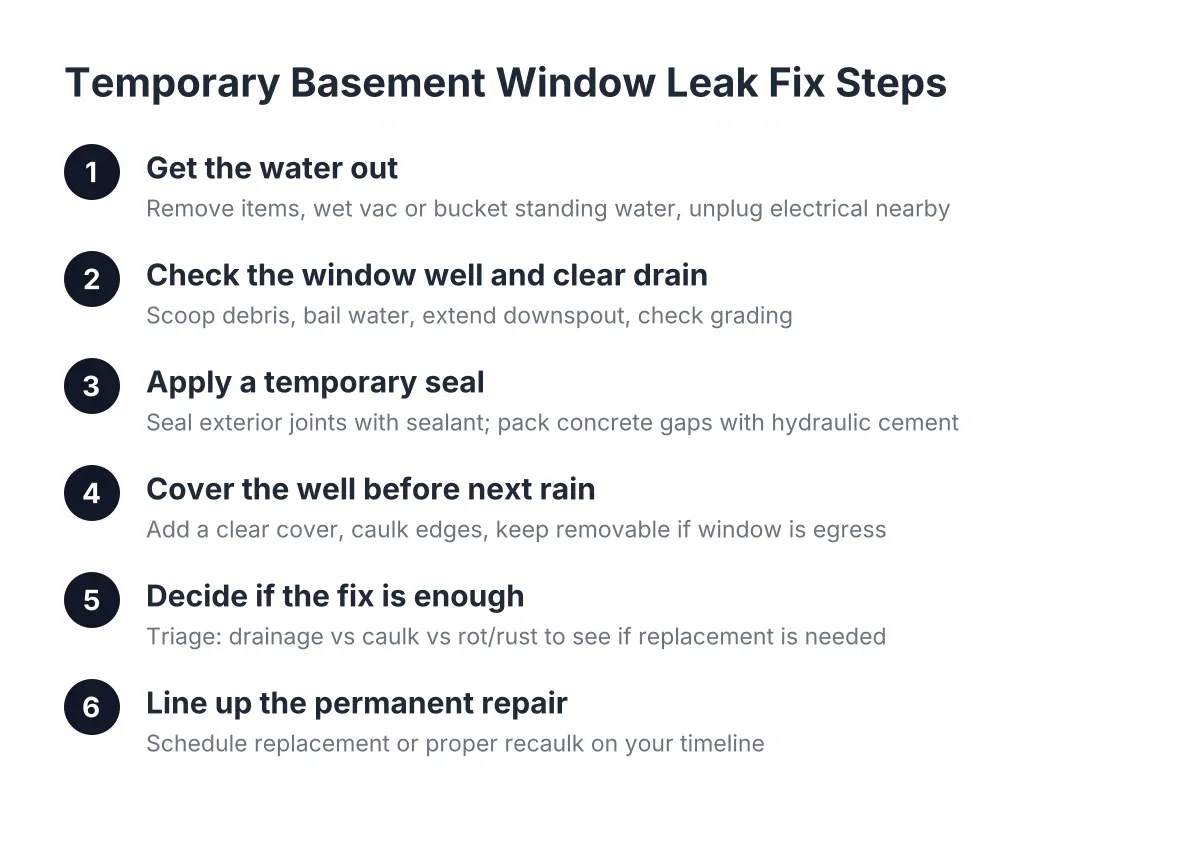
Put a towel or a shallow pan under the drip. Move anything stored near the window, especially cardboard and anything with fabric. If the window well outside is filling with water, bail it with a bucket or run a small utility pump if you have one. A window well that fills past the bottom of the window frame will push water through any weak point in the seal, and no caulk on earth stops standing water pressed against a window.
If water is coming in fast, as in a steady stream rather than a drip, and the well outside looks like a bathtub, the well drain is likely clogged or missing. That is the problem to chase, not the window. Hold that thought for Step 3.
Step 2: Find Where the Water Actually Enters
Can water leak through a window frame? Yes, but it enters through a gap, not through the glass or the sash itself. Water follows gravity and the path of least resistance, so the drip point at the top of your frame can sit a foot or more below the real opening. Your job in this step is to trace the water upward until you find dry material.
Grab a flashlight and check these spots in order:
- The gap between the top of the window and the frame or buck. Some replacement windows have a removable cap at the top that is meant to be sealed with caulk. If that cap is loose or the caulk has split, water gets in here first.
- The joint where the window frame meets the concrete or block. Old mortar and caulk shrink and crack. Run a dry finger along the joint; if it comes back wet above the drip point, you found your entry.
- The wall above the window. If the drywall or block above the window is damp, the water is coming from higher up. That could be a sill plate gap at the top of the foundation, a crack in the block, or even a leak at a first-floor window above that is running down inside the wall.
- Inside a finished wall. If the basement is finished and the drywall around the window is soft, stained, or bubbling, water has been leaking into the wall for longer than today's rain.
Mark the highest wet point with painter's tape. Everything below it is just the water's exit route.
Step 3: Diagnosing Window Leaking Into Wall From the Well and Drainage Outside
Why does my window well flood? A window well floods when more water enters it than its drain can carry away, usually because the drain is clogged with leaves and silt, the well has no drain at all, or a downspout dumps roof water right next to it. In older Minneapolis homes with original wells, a missing or buried drain is common.
Go outside during or right after the rain and look at three things:
- Standing water in the well. If the gravel at the bottom holds water for more than a few minutes after rain stops, the drain is clogged or absent. Water sitting against the frame is the number one cause of a basement window leaking after rain.
- Downspouts and grading. A downspout that ends within a few feet of the well, or soil that slopes toward the house, feeds the well faster than it can drain. This is the cheapest fix on this whole list.
- The well itself. A rusted-through galvanized well or one that has pulled away from the foundation lets soil and water pour in behind it. A well that has shifted is a replacement, not a repair.
A window well cover with a bead of caulk around its edge keeps rain, leaves, and snowmelt out of the well in the first place. For a well that only floods during the worst storms, a cover plus a cleared drain often ends the problem for the cost of a weekend afternoon.
Step 4: Water Leaking Into Wall Structures From Higher Up
Window leaks from top when it rains are sometimes not basement problems at all. Water that enters at a first-floor window, a siding gap, or the joint where the foundation meets the framing can travel down studs and show up dripping at the basement window below, with water leaking into wall structures visible at the lower window frame. If the highest wet point you found in Step 2 is above the basement window frame, you are in this category.
Check the window directly above the leak on the first floor. Look for cracked exterior caulk, missing flashing above its frame, or gaps where siding meets trim. A window air conditioner left in through fall can also channel rainwater into the wall below it, and a window AC leaking into wall framing looks identical to a window leak from inside the basement.
This matters for your budget. Sealing a basement window joint is a DIY job. Water traveling down inside a wall from the floor above usually means opening drywall or pulling exterior trim, and that is where a professional eye saves you from sealing the wrong gap and trapping water inside the wall.
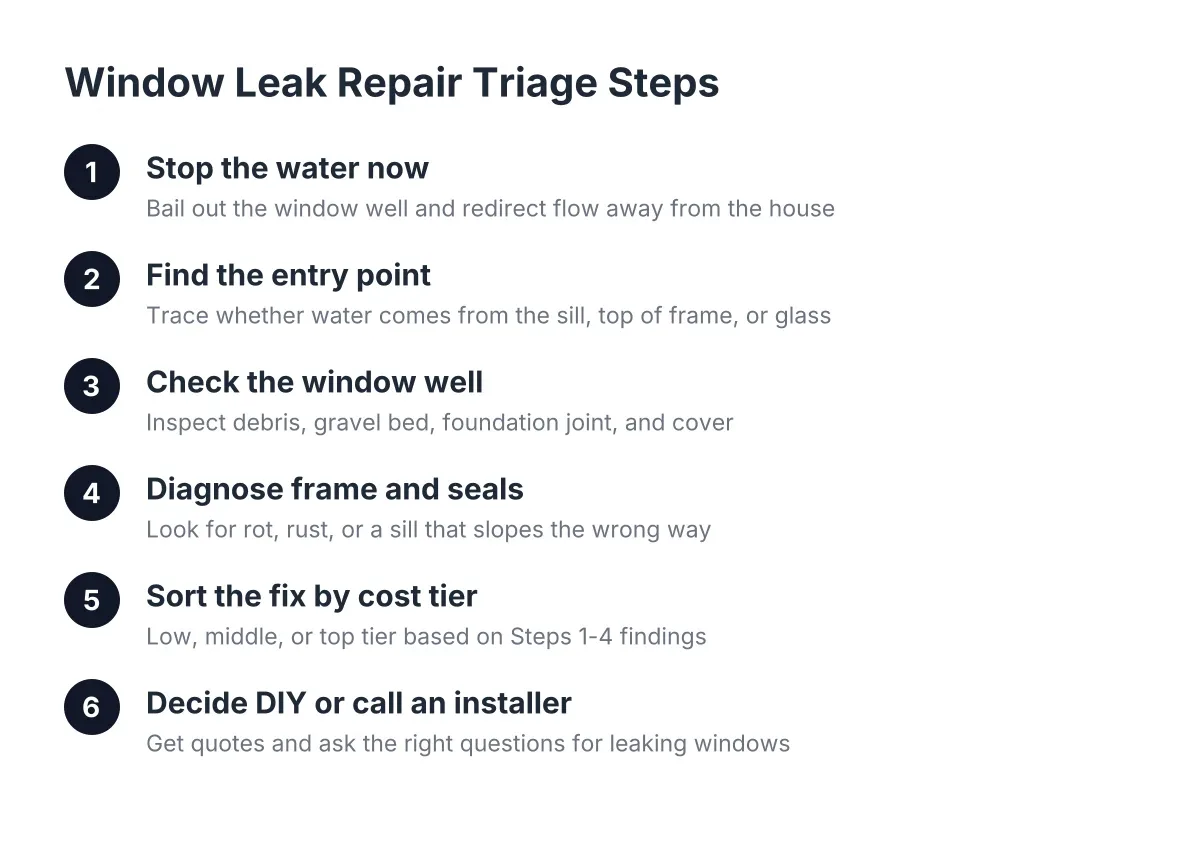
Step 5: Match the Cause to the Fix and the Rough Cost
Now you can sort your problem into one of three buckets. Pricing varies by project and house, so treat the DIY figures as illustrative estimates, not quotes.
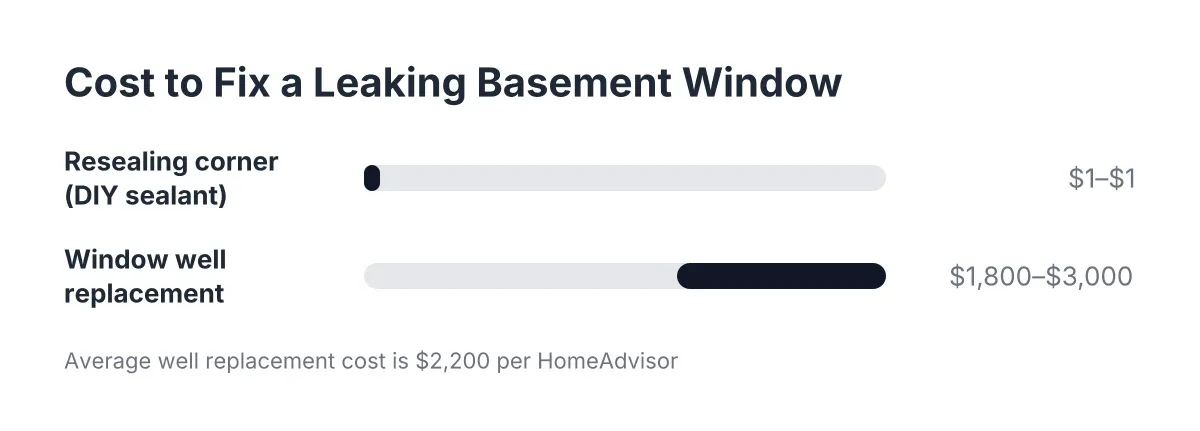
- The cheap bucket: drainage and sealant. A clogged well drain, a bad downspout, a missing well cover, or failed caulk at the top of the frame. Suppose a homeowner in South Minneapolis finds the well drain packed with maple leaves and the caulk above the frame cracked. In that scenario, a well cover, a tube of high quality exterior sealant, and an hour of drain clearing might run under $100 in materials. This is the fix most people hope for, and it is more common than the scary ones.
- The middle bucket: well or window replacement. A rusted well, a rotted frame, or a window with seal failure that fogs and leaks needs replacement, not caulk. For reference, HomeAdvisor reports window well replacement averages $2,200, with most homeowners spending between $1,800 and $3,000. Basement window replacement itself is often the simpler half of that work.
- The big bucket: egress or structural work. If you are already planning a finished basement and the leaking window is an old block or hopper unit, this is the moment to think about an egress window instead of patching a window you will replace anyway. According to HomeAdvisor, installing an egress window averages $4,229, with most homeowners spending between $2,723 and $5,877. That number includes cutting the foundation opening and installing the well, which is the part no weekend project should attempt. Cutting concrete wrong compromises both the seal and the wall.
One honest trade-off: sealant over a joint that is still moving or still wet is a patch, not a fix. Plenty of homeowners end up frustrated because a quick caulk job looked done, then failed the next spring. If the same joint has been caulked before and leaked again, the window or the drainage behind it is the problem.
Step 6: Decide What to DIY and Who to Call for a Leaking Window
Who should you call for a leaking basement window? Call a window installer who does basement window replacement when the frame, seal, or well is the problem; call a waterproofing company when water comes through the foundation wall itself, away from any window. The wet-spot map you made in Step 2 tells you which one you need before anyone quotes you.
Handle these yourself if you are handy:
- Clearing the well drain and adding a cover
- Extending downspouts and regrading soil away from the well
- Recaulking the joint between frame and concrete with exterior sealant, once everything is dry
Bring in a local installer for these:
- Replacing a rusted well or installing window well drainage
- Full-frame replacement of a rotted or chronically leaking basement window
- Any egress window work, which involves cutting the foundation and, in Minneapolis, meeting code compliance for bedroom egress requirements
- Any case where drywall is wet and you cannot find the entry point, because sealing the visible gap can trap the leak inside the wall
Basement window leaks are also worth a professional look when you are mid-project on a basement finish. A new window set level, with the sill sloped slightly outward so water drains away from the opening, is cheap insurance compared to pulling new drywall in two years. If you are getting quotes in 2026, ask the installer to explain where the water was entering, not just what they plan to install; a straight answer on the cause is the best sign you are paying for a fix and not a patch.
The good news is that most top-of-frame drips trace back to the well or the caulk, not the window. Work the steps in order, mark the highest wet point, and you will know within an hour whether this is a $100 Saturday or a project worth a real quote.
If you need basement egress window installation, Minneapolis Window Pros can help.
Prefer to talk it through? Call (612) 482-9787 — a quick call is usually the fastest way to get a straight answer for your situation.