
Basement Window Leaks — Complete Guide
A basement window leaking after rain is one of those problems that goes from annoying to expensive fast. This guide covers why basement windows and window wells leak, how to triage the problem in the next hour, and how to tell a $200 reseal apart from a $3,000 well replacement. If you have water coming in right now, you need answers before you start searching for window repair near me and calling the first name that pops up. Below, you will find a clear map of the causes, the costs, and the point at which a Minneapolis pro should take over.
What You'll Find in This Guide
- Basement Window Leaks Terms Explained: A Plain-English Glossary
- Window Leak Repair Cost: What Really Drives the Price?
Why Your Basement Window Is Leaking After Rain
Water at a basement window almost always traces back to one of four causes. Knowing which one you have changes everything about the fix, the urgency, and the price.
First, look at the window well. In Minneapolis, most below-grade windows sit inside a metal or plastic well dug into the soil. When that well fills with water faster than it drains, the water level rises against the glass. Eventually it finds a gap and pours through. This is the classic "why does my window well flood" scenario, and it usually points to a clogged drain, compacted soil, or a well that was never connected to drainage in the first place.
Second, check the seal around the frame. Basement window seal failure happens quietly over years. Caulk shrinks, mortar joints crack, and old wood frames rot at the sill. As a result, even modest rain can push water through gaps you cannot see from inside.
Third, consider grading. If the soil around your foundation slopes toward the house, every storm sends runoff straight at your windows. Gutters that dump next to the foundation make this worse.
The Minneapolis Factor: Frost, Clay, and Old Wells
Fourth, and specific to our market, frost movement matters. Minneapolis frost depth runs deep, and freeze-thaw cycles shift soil against window wells every winter. Over time, that movement separates the well from the foundation wall or crushes older corrugated wells out of shape. Clay-heavy soil in many Twin Cities neighborhoods drains poorly, so wells hold water longer after each rain.
To put it simply, a leak is a symptom. The cause is almost always drainage, sealing, grading, or a failing well. If the vocabulary gets confusing when you start researching, our plain-English glossary of basement window leak terms sorts out the jargon so you can read a quote or a forum thread without guessing.
Stop the Water First: Emergency Triage for an Active Leak
If water is coming in your basement window fast, act in this order. You are trying to slow the water, protect what it can ruin, and buy time for a real fix.
Start outside. Go look at the window well, even in the rain. If it holds standing water, bail it out with a bucket or a wet vac. Then check the well drain if you can see one, and clear leaves, mulch, or debris blocking it. Additionally, redirect any downspout that discharges near the well. A single relocated downspout extension stops a surprising number of "basement flooding through window" emergencies.
Move inside next. Pull anything absorbent away from the window: carpet, boxes, drywall-adjacent furniture. Set a fan on the wet area and run a dehumidifier if you own one. Speed matters here because mold can start on wet materials within a day or two. The University of Minnesota Extension guide on moisture in basements is a solid reference on why fast drying prevents bigger indoor air problems.
Temporary Fixes That Actually Hold
Once the immediate flow slows, you can buy time with a few honest stopgaps. Clear plastic sheeting taped over the exterior of the window sheds rain until a repair happens. A basic window well cover, even a cheap one, keeps direct rainfall out of the well. Inside, exterior-grade caulk over a visible frame gap can hold for weeks.
However, be honest with yourself about what these are. They are bandages, not repairs. If water reached the window because the well flooded, the well will flood again in the next storm. That said, these steps often turn a middle-of-the-night emergency into a scheduled appointment, which is worth a lot. For a sense of what that appointment will cost, our window leak repair cost guide walks through the price drivers before anyone sets foot on your property.
Finding Window Repair Services Near You: When to DIY and When to Call a Pro
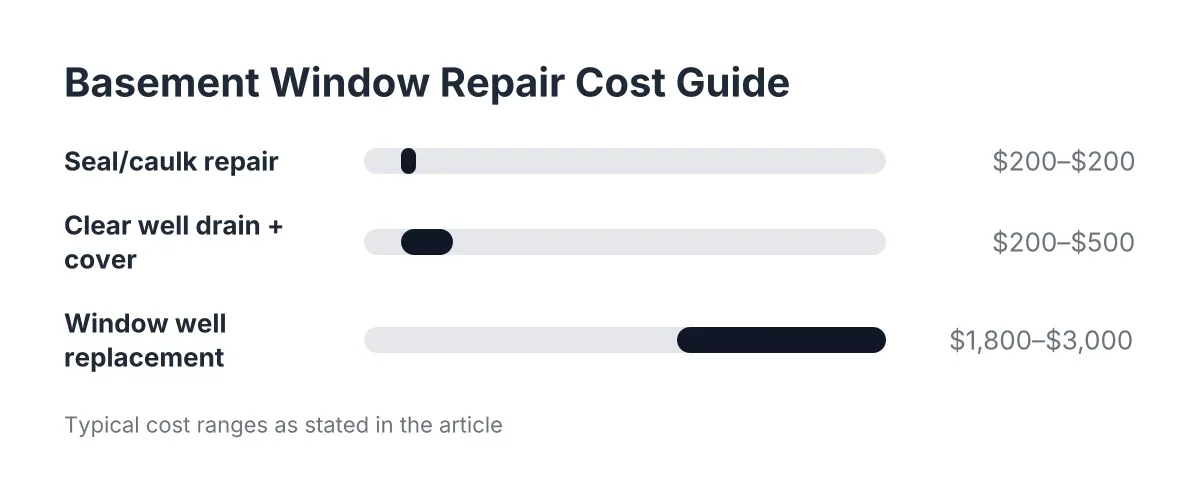
Every homeowner with a wet basement eventually searches for window repair near you. Before you do, it helps to know which fixes are genuinely DIY, which need a contractor, and what a fair price looks like. This is the difference between a $200 weekend project and a $3,000 excavation, and you should know which one you are facing before the first phone call.
You can reasonably handle three things yourself. Resealing a frame with caulk costs under $20 in materials. Clearing a well drain and adding gravel is a shovel-and-gloves job. Extending downspouts and regrading a small strip of soil takes an afternoon. If your leak stops after these, congratulations, you had the cheap version of this problem.
Beyond that, call a professional. A rotted or rusted frame needs a full basement window replacement, because caulk cannot bridge failed structure. A collapsed or detached window well needs excavation and a new well, often a galvanized one that stands up to Minneapolis frost cycles. According to HomeAdvisor, window well replacement averages $2,200, with most homeowners spending between $1,800 and $3,000. Recurring flooding with no visible cause usually means a drainage problem below grade, and that requires digging, not guessing.
If You're Upgrading, Know the Code Numbers
For example, many homeowners use a leak as the trigger to finally install a proper egress window in a finished basement or bedroom. That is a bigger project with real code requirements. HomeAdvisor notes that IRC egress code requires a well projecting at least 36 inches from the house with a nine square foot footprint, plus a minimum net clear opening of 5.7 square feet. On cost, Angi reports egress window installation averages $4,244 nationwide, with most homeowners spending between $2,723 and $5,898 per window.
With this in mind, screen any contractor you find through searching for window repair near me the same way. Ask whether they will diagnose the cause, not just patch the symptom. Ask if they know Minneapolis frost depth and local well styles. And ask for a real quote in writing, not a range that doubles once they arrive.
Ready to Get Started?
If your basement window is leaking and you want a straight answer instead of a sales pitch, we can help. We install and replace basement windows and egress wells across Minneapolis, and we tell you up front whether you need a reseal, a replacement, or a new well, with a real number attached. Reach out, describe what you are seeing, and we will tell you exactly what it takes to fix it for good.