Temporary Basement Window Leak Fix: Stop Water Before You Call Anyone
Water is coming in through your basement window right now, or it did during the last storm, and you need it stopped before it does more damage. This guide walks you through a temporary window leak fix step by step: what to do in the next hour, what to do before the next rain, and how to tell whether you are looking at a cheap patch or a window replacement. If you are selling the house and an inspector already flagged the window, the triage below also tells you what a buyer will accept and what they will not.
Quick answer up front. Most leaks come in one of three ways: through a flooded window well, through failed caulk or glazing around the window itself, or through gaps in the foundation concrete around the frame. A well problem is usually a drainage fix. A caulk problem is a tube of sealant and an afternoon. Additionally, a rotted or rusted frame usually means basement window replacement, and in Minneapolis that often raises the egress question too.
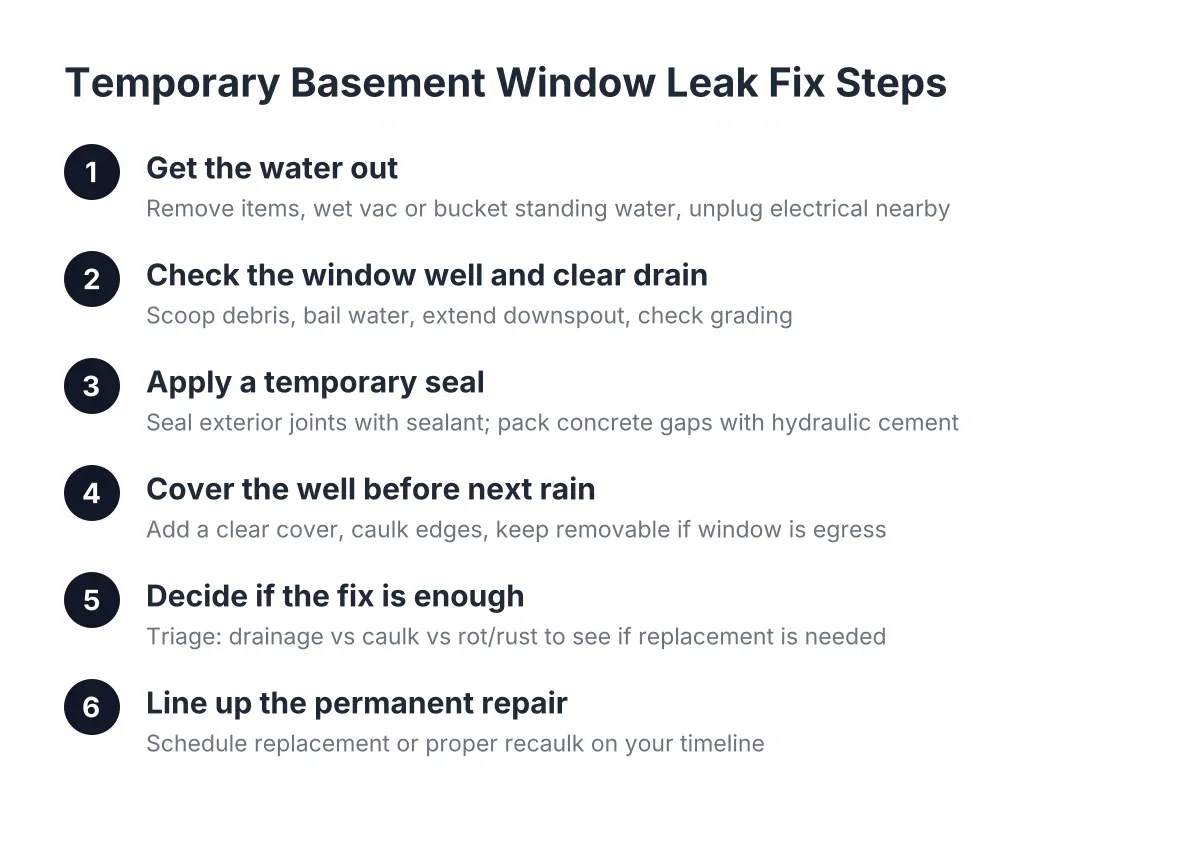
Step 1: Get the Water Out and Protect What You Can
First, deal with the water, not the window. Move boxes, furniture, and anything electrical away from the wet area. If water is pooling, use a wet vac, a sump pump, or towels and a bucket. Unplug anything near standing water before you touch it.
Next, look at the window from inside while it is still leaking if you can. Where the water enters tells you what is broken:
- Water running in over the sill or through the sash: the window well outside is likely full of water.
- Water seeping at the edges of the frame: the caulk or seal between the window and the foundation has failed.
- Water weeping through the concrete around the window: there is a gap or crack in the foundation at the opening.
Take photos with your phone. If you are a seller working against a closing date, dated photos of the leak and your fix show the buyer you addressed the problem instead of hiding it.
Step 2: Check the Window Well and Clear the Drain
Go outside and look into the window well. In Minneapolis, most window well floods come from the same short list: leaves and debris plugging the gravel at the bottom, a downspout dumping roof water next to the well, or soil that has settled so the yard now slopes toward the house.
Therefore, do these in order:
- Scoop out leaves, mulch, and debris down to the gravel at the bottom of the well.
- Bail or pump out standing water so the well can drain.
- Extend any nearby downspout at least a few feet past the well, even with a cheap plastic extension.
- Check the grade. If soil has settled against the foundation, mound soil to slope water away as a stopgap.
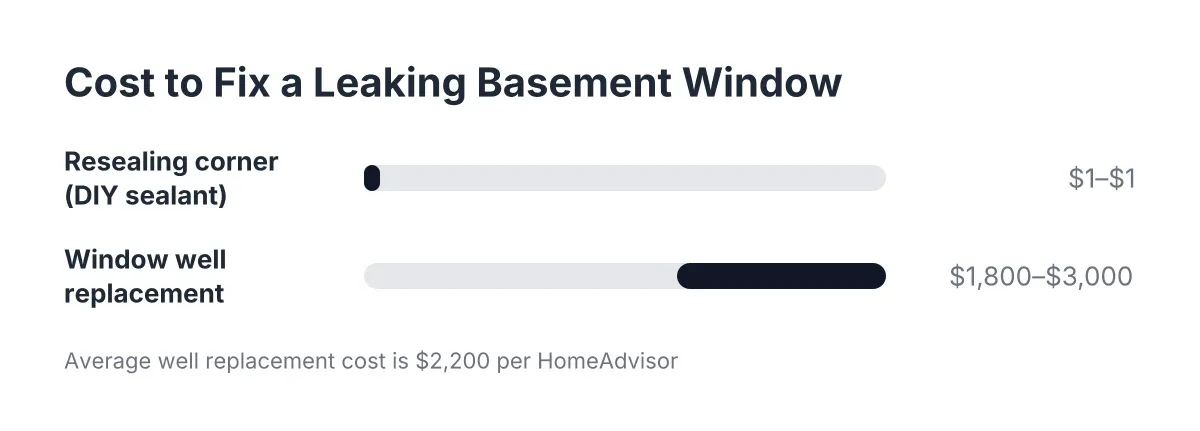
If the well fills every time it rains even when the gravel is clear, the drainage below the well has failed or was never built. That is not a caulk problem, and no amount of sealant at the window will beat a well that holds a foot of water. Window well replacement averages $2,200, with most homeowners spending between $1,800 and $3,000, according to HomeAdvisor. A galvanized well with proper drainage is the durable version of this fix.
Step 3: Apply a Temporary Basement Window Leak Seal
Once the well is drained and dry, seal the obvious entry points. This is the true temporary window leak fix for your basement, and it can hold through a Minnesota season if you do it on a dry surface.
Work the exterior first. Run a continuous bead of polyurethane or high quality exterior sealant along the joint where the window frame meets the foundation, across the top, down both sides, and along the bottom. Smooth it with a gloved finger so it fills the joint instead of bridging it. Do the same where the window well meets the foundation wall; a gap there lets groundwater slip behind the well and straight to the window.
For gaps in the concrete itself, sealant is not enough. Pack larger gaps or crumbled spots with rapid-setting concrete or hydraulic cement, let it cure, then seal the remaining joints. You can paint it later to match the foundation; the buyer's inspector cares that it is solid, not pretty.
Inside, you can press rope caulk or removable sealant into drafty joints as a short-term barrier. Skip spray foam as a leak fix; it blocks air, not water, and it makes the eventual proper repair messier.
Step 4: Cover the Well Before the Next Rain
A clear window well cover is the cheapest insurance you can buy against the next storm. It keeps rain, snowmelt, and debris out of the well while still letting light in. Run a bead of caulk around the edge where the cover meets the foundation and the well, and water has no easy path down to the window.
However, check one thing before you cover the well. If the basement window serves a bedroom, the cover must be removable from inside without tools, because that window is an emergency exit. A screwed-down cover over an egress window is exactly the kind of thing a buyer's inspector writes up.
Step 5: Decide Whether the Temporary Basement Window Leak Fix Is Enough
How long does a temporary window leak fix last?
A well-applied exterior sealant job on a sound window can hold for a season or two, sometimes longer. It fails fast when the underlying problem is drainage, rot, or rust. Caulk over a rusted steel frame or a rotted wood sash is a bandage on something that keeps moving, and Minneapolis freeze-thaw cycles will open the joint again by spring.
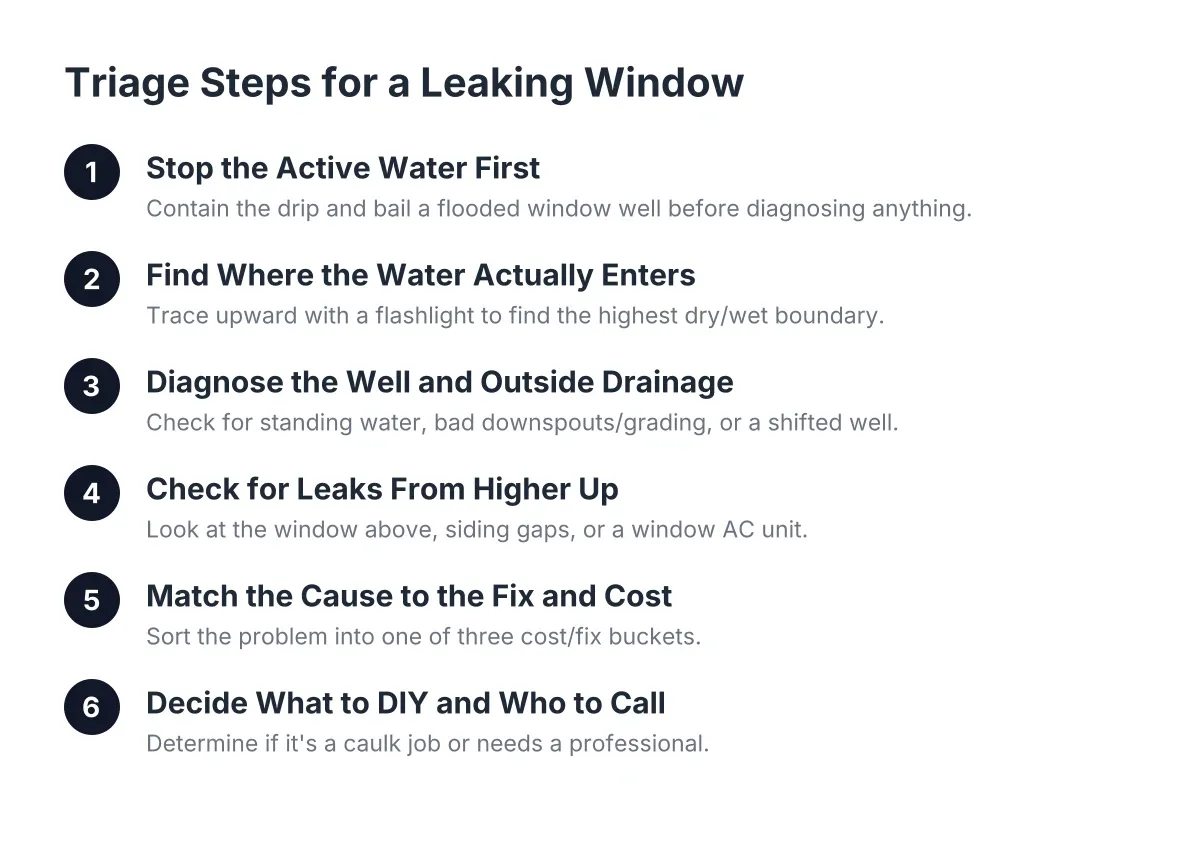
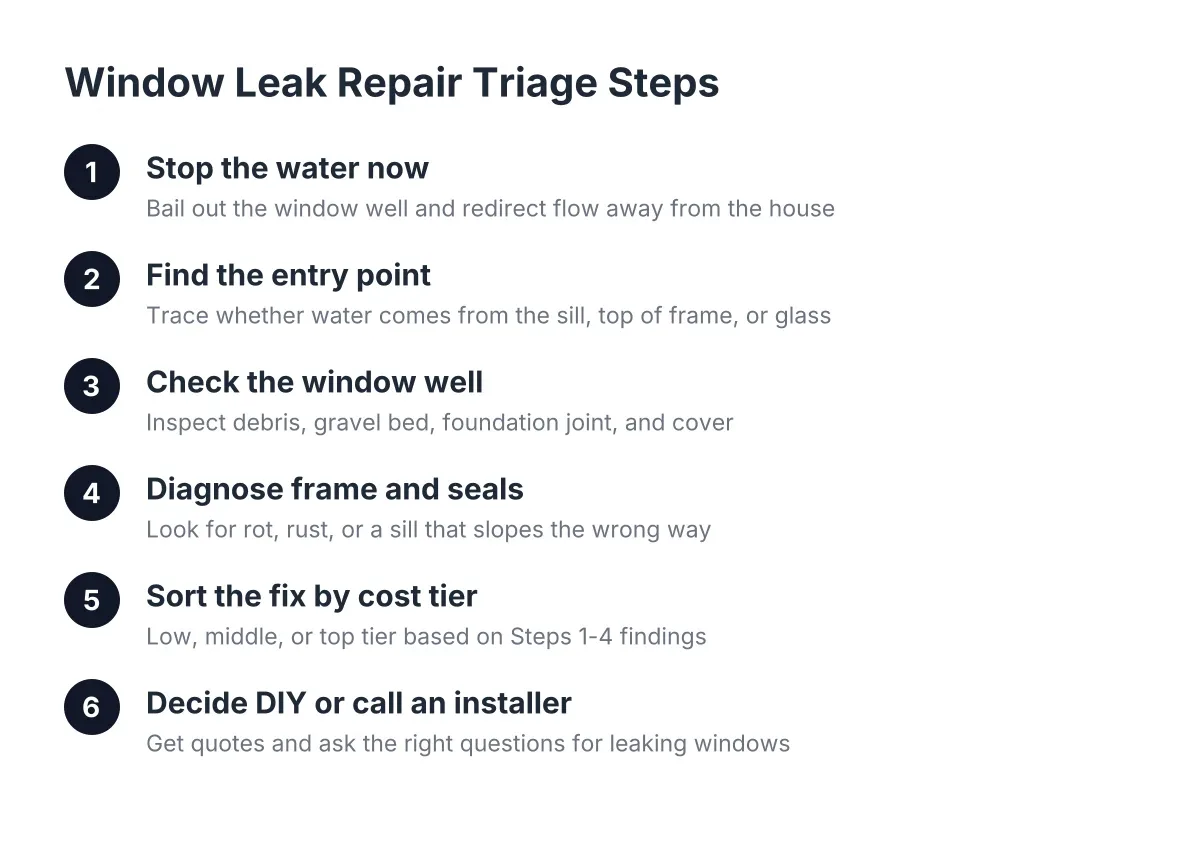
Use this rough triage to size the real fix:
- Clogged well, bad grading, or a missing cover: usually a weekend and under a couple hundred dollars in materials. Your temporary fix may be the permanent fix.
- Failed caulk on a solid window: a tube or two of sealant now, and plan to recaulk properly in dry weather.
- Rusted steel frame, rotted sash, fogged glass, or a window that no longer closes square: plan on basement window replacement. Glass block windows are a durable option for utility spaces; an operable window is required where egress applies.
- A well that floods from below, or water coming through foundation cracks away from the window: bring in a professional. Drainage and foundation water problems are beyond a sealant fix, and guessing wrong costs more than the diagnosis.
What this means if you are selling the house
Suppose an inspector flagged two leaking basement windows and your closing is six weeks out. In that scenario, the smart sequence is: do the drainage and sealant triage above this week, document it with photos, then get a written quote for replacing any window that is past patching. A documented quote in hand keeps the repair from becoming a renegotiation lever; the buyer sees a known number instead of an unknown risk.
Know the code question before the buyer's attorney asks it. If a basement room is listed as a bedroom, it needs a compliant egress window, not just a dry one. Under the IRC egress code, the window needs a minimum net clear opening of 5.7 square feet, with a well that projects at least 36 inches from the house and has a nine square foot footprint, according to HomeAdvisor. The City of Minneapolis rental checklist likewise requires a proper egress window or door opening to the outside for each bedroom. As of 2026, expect any buyer's inspector in the Twin Cities to check this.
On cost, installing an egress window averages $4,229, with most homeowners spending between $2,723 and $5,877, according to HomeAdvisor. Angi puts an egress window plus well at about $3,900 on average, with a window well alone running $500 to $1,500 or more. Your actual number depends on the foundation, the well style, and whether the opening needs to be cut larger; a local window installer can quote your specific opening, and quotes are typically free.
Step 6: Line Up the Permanent Repair on Your Timeline
Finally, schedule the real fix while the temporary one is holding. Searching window leak repair near me will surface everyone from handymen to national chains; for a basement window, you want someone who will talk about the well, the drainage, and the foundation joint, not just the glass. Window leak repairs near me is a fair search, but ask each contractor the same three questions: what is causing the leak, what exactly will you do about the well, and does egress code apply to this opening.
Basement window leaks almost always trace back to water management outside the glass, which is why the durable fix often pairs a replacement window with window well installation or well drainage work done at the same time. In Minneapolis, frost depth and soil conditions shape how a well and its drainage should be built, so local knowledge matters more here than on an upstairs double-hung.
One honest caveat: if water also comes through floor cracks, the cove joint, or walls away from the window, the window may be a symptom, not the source. That pattern points to a grading or drain tile problem, and a waterproofing assessment should come before any window work.
The bottom line for triage. A flooded well with a healthy window is often a $100 to $300 fix in materials. Failed sealant is a tube of caulk and an hour. A failed window, or a missing egress window in a bedroom, is a replacement project in the low thousands. Stop the water first with the steps above, then match the permanent fix to what you actually found.
If you need basement egress window installation, Minneapolis Window Pros can help.
Prefer to talk it through? Call (612) 482-9787 — a quick call is usually the fastest way to get a straight answer for your situation.