Weather Stripping Small Basement Windows: Stop Minneapolis Winter Leaks
If water is coming in through your basement window during a rainstorm or a February thaw, weather stripping is one of the first things to check. Small basement windows in older Minneapolis homes leak for a short list of reasons, and worn or missing seals rank high on that list. The good news is that the fix is often not a full excavation project. The tricky part is that most of the advice online assumes a standard-size window, and older homes here rarely have one. This guide walks through how to seal a small, non-standard basement window opening, what weather stripping can and cannot fix, and when the real answer is basement window replacement.
Why Small Basement Windows Leak in Minneapolis Winters
Minneapolis basements take a beating that windows in most of the country never see. Frost pushes soil against the foundation. Snow piles against window wells, then melts fast during a warm spell. Ice forms in the well, blocks the drain, and the next melt has nowhere to go but through the window.
Older homes make this worse. Houses built before the 1960s often have small basement windows set in openings that no hardware store kit matches. The original steel or wood frames were sized to the block coursing of the foundation, not to any modern standard. When homeowners squeeze a stock window into that opening, the gaps get bridged with caulk and hope. That works until the first hard freeze.
Here is the pattern most homeowners see. Water shows up after heavy rain or a fast snowmelt. It runs in along the bottom of the sash, or it seeps where the frame meets the concrete. The window itself may look fine. The failure is in the seals around it: the sash gasket, the sealant between frame and masonry, or the window well outside.
Therefore, before you assume the worst, sort the problem into one of three buckets:
- Air and minor water at the sash. The window closes but does not seal tight. This is a sash-gasket problem, and it is the cheapest fix on this list.
- Water at the frame edges. The gap between the window frame and the foundation has opened up. This needs exterior sealant work, and sometimes interior foam.
- Water filling the window well. The well itself is failing, the drain is blocked, or grading pushes water toward the house. No amount of sash sealing will fix this one.
The rest of this guide takes these in order, because that is the order of cost and effort.
What Weather Stripping Can Fix on a Basement Window
Weather stripping on a basement window seals the moving parts: the gap between the sash and the frame. It stops drafts, slows heat loss, and blocks wind-driven rain and fine snow from sifting through. It cannot stop standing water, and it cannot seal a gap between the frame and the concrete around it.
That distinction matters because it decides who you call and what you spend. If your basement is cold near the window, if you feel a draft when you hold your hand near the sash, or if frost forms on the inside of the glass, a worn sash seal is a likely cause. If water pools in the well and pours through, you have a drainage or installation problem, and new foam tape will not save you.
Old basement windows are the worst offenders for failed seals. Steel awning windows from mid-century Minneapolis homes often have no functional gasket left at all. The original felt or rubber dried out decades ago. Wood sashes swell and shrink with humidity, so the gap changes size through the year. By the time a homeowner notices, the window has been leaking air for years and water for a few storms.
Seal Types That Work in a Cold Basement
Not every product on the weatherization aisle survives a Minnesota basement. Concrete and steel frames stay cold and damp, and adhesives that work on a warm front door fail down there. As of 2026, these are the options that hold up:
- EPDM rubber or silicone bulb seals. These compress when the sash closes and spring back. They handle freeze-thaw cycles better than vinyl and stay flexible below zero.
- High-density foam tape. Cheap and easy, but the adhesive needs a clean, dry, warm surface to bond. Applied to a cold frame in November, it peels by January. Install it in warm weather or warm the frame first.
- Spring metal or V-strip. Durable and good for old wood sashes with uneven gaps. It takes more patience to install but outlasts foam by years.
- Silicone caulk as a gasket. For windows that never open, a bead of removable sealant around the sash acts as a seasonal seal. Some Minneapolis homeowners close up fixed basement windows this way every fall.
Skip the felt strips. They absorb moisture, and a damp basement window is exactly where they fail fastest. The same logic that applies to weatherstripping an exterior door applies here: match the material to the gap size and the conditions, and clean the surface before anything sticks.
How to Install Weather Stripping on a Small Basement Window
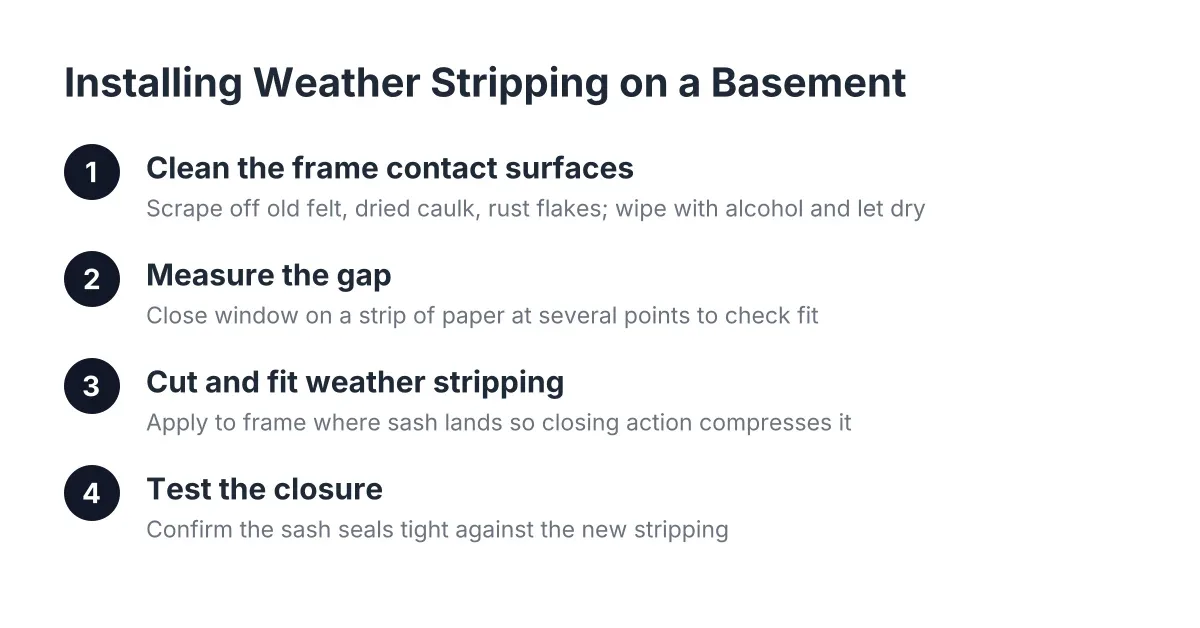
First, open the sash and clean the frame contact surfaces. Scrape off old felt, dried caulk, and rust flakes. Wipe with rubbing alcohol and let it dry. Adhesive-backed products fail on dirty surfaces more than for any other reason.
Next, measure the gap. Close the window on a strip of paper at several points. If the paper slides out easily, the gap there is too wide for the seal. Gaps vary on old windows, so you may need thicker material on one side than the other.
Then cut and fit the weather stripping to each side of the sash or frame, depending on the window style. Awning and hopper windows, the common styles in small basement openings, seal against the frame when they close. Apply the seal to the frame where the sash lands, not to the sash edge itself, so the closing action compresses it.
Finally, test the closure. The sash should close with light resistance and latch fully. If you have to force it, the seal is too thick and will tear or pop loose. If it closes with no resistance, size up.
This is a one-hour job on most small windows and one of the few basement fixes a homeowner can do safely without a contractor. However, if the sash is rotted, rusted through, or no longer sits square in the frame, no seal will bridge that. That window is a replacement candidate, and it is worth having a local installer look at it rather than re-sealing it every fall.
Sealing the Frame to the Foundation
The second leak path is the joint between the window frame and the concrete or block around it. In older Minneapolis homes, this joint has often been patched repeatedly with whatever caulk was on hand. Each layer traps moisture behind the last one, and freeze-thaw cycles pop the whole mess loose.
Done right, this joint gets a high-quality exterior sealant rated for masonry, applied along the sides and top of the frame. The bottom is different. Leave the bottom of the sill unsealed on the exterior, or drainage-path it, so any water that gets behind the frame has a way out. Sealing all four sides traps water against the frame, and trapped water is what rots wood frames and rusts steel ones from behind.
On the interior side, low-expansion window and door spray foam fills the gap between the frame and the foundation. Use it moderately. Overfilled foam bows frames and has to be trimmed back later. A modest, continuous fill blocks drafts and gives the interior trim something solid to land against.
For example, suppose a homeowner in Northeast Minneapolis notices water staining below a basement window after every hard rain. The sash seals fine, but a flashlight along the frame edge shows daylight at one top corner. In that scenario, the fix is cutting out the failed caulk, cleaning the masonry, and running fresh exterior sealant along the sides and top. That is an afternoon of work, not a construction project, and it often ends the leak for years.
One honest caveat: if the concrete around the opening is cracked or spalling, sealant alone is a band-aid. Concrete repair has to come first, then the remaining gaps get sealed to weatherproof the installation. A local installer can tell you in one visit whether you are looking at a sealant job or a masonry job.
When the Window Well Is the Real Problem
If water fills the window well and rises against the glass, stop shopping for weatherstripping. The well is failing, and everything inside it will keep leaking until the well works again.
A window well should do three things: hold soil back from the window, drain water down and away, and stay sealed to the foundation where its flanges meet the wall. When any of those fail, storms send water straight at the lowest, weakest point of your foundation, which is the window.
Common well failures in Minneapolis homes include:
- A blocked or missing drain. Wells should drain to gravel below or tie into the drain tile. Leaves, ice, and silt block them, and many older wells never had a drain at all.
- A rusted-out or collapsed well. Corrugated steel wells rust at the soil line. Once the wall deforms, soil and water push in.
- A broken seal at the foundation. The well attaches to the foundation wall, and that joint needs a continuous bead of polyurethane sealant from bottom to top. When it fails, groundwater slips behind the well and finds the window frame.
- Grading that slopes toward the house. If the yard sends water at the well, the drain fights a losing battle every storm.
A galvanized well with a working drain, sealed to the foundation, solves most of these at once. Adding a clear well cover, caulked around its edge, keeps rain and melting snow out of the well entirely, which is the simplest insurance an older basement window can get. According to HomeAdvisor, window well replacement averages $2,200, with most homeowners spending between $1,800 and $3,000, so a failing well is a real project but a bounded one.
Window well installation is not a DIY-friendly job in frost country. The well has to sit at the right depth, the drain has to reach gravel or tile, and the backfill has to be graded for drainage. Get that wrong and you have rebuilt the same leak with new parts.
Replacing a Small Basement Window That Will Not Seal
Sometimes the honest answer is that the window is done. Rusted steel frames, rotted wood bucks, and sashes that no longer close square cannot be sealed back to health. At that point the question shifts from repair to basement window replacement, and non-standard sizing is where older Minneapolis homes get complicated.
Stock windows come in standard sizes. Old foundation openings do not. The workable approach is to measure the rough opening and order a window slightly smaller in both width and height, which leaves room to set it level, shim it square, and seal the perimeter. Correct alignment during installation is what prevents air leaks and water intrusion later. A window forced into a tight opening, or one racked out of square, will leak no matter what seal goes on it.
For odd-sized openings, homeowners have a few paths:
- Basement window replacement inserts sized to fit inside the existing frame, which avoids masonry work but shrinks the glass area.
- Custom-sized windows built to the actual opening, which cost more per unit but seal correctly and keep the full opening.
- Glass block windows for openings that never need to open, which are mortared in, seal permanently, and shrug off window well moisture. Block windows are a common choice for laundry and utility areas in older homes.
- Enlarging the opening by cutting the foundation, which is the route when a bedroom needs a code-compliant egress window rather than a small fixed unit.
That last option matters if the room is or will become a bedroom. Minneapolis code requires each bedroom below the fourth floor to have a window at least 20 inches wide by 24 inches high with nothing blocking it, according to City of Minneapolis. Under the International Residential Code, an egress window needs a net clear opening of at least 5.7 square feet, and its window well must extend at least 36 inches out from the house (IRC Section R310). Most small basement windows in older homes do not come close. Sealing a too-small window in a finished basement bedroom locks a code problem in place; it does not solve it. Cutting the foundation to enlarge an opening is precision work, since the cuts determine whether the new window fits, seals, and leaves the wall structurally sound. That is installer work, not a weekend project.
Cost-wise, sealing work sits at the bottom of the range and structural work at the top. According to HomeAdvisor, installing an egress window averages $4,229, with most homeowners spending between $2,723 and $5,877. Your project may land differently depending on the opening, the well, and the soil, which is why a real quote against your actual foundation beats any national average.
A Fall Sealing Checklist for Minneapolis Basements
The cheapest leak is the one that never happens. Before the ground freezes each fall, run through this list on every basement window:
- Clean leaves and debris out of each window well and confirm the drain takes water.
- Check the well cover, or add one, and refresh the caulk bead around its edge.
- Inspect the exterior sealant at the sides and top of each frame; recaulk any cracked or lifted sections.
- Open each operable sash, inspect the seal, and replace any strip that is flattened, torn, or missing.
- Confirm grading still slopes away from each well after summer settling.
- Inside, look for staining, peeling paint, or efflorescence below each window, which flags a leak you have not caught yet.
An hour in October beats a wet carpet in March. If a window fails more than one item on this list two years running, it is telling you something, and the answer is usually replacement rather than another tube of caulk.
Sorting the Fix from the Symptom
Water at a basement window has three possible sources: the sash, the frame joint, or the well. Weather stripping handles the first, exterior sealant handles the second, and well repair or replacement handles the third. Match the fix to the actual leak path and you spend once. Guess wrong and you buy the same storm damage again next spring.
For Minneapolis homeowners with older, odd-sized openings, the sizing question runs underneath all of it. A window that fits the opening, sits level, and seals on all the right surfaces will hold through winters that destroy a forced-fit stock unit. When the fix runs past sealant, a local installer who knows Minneapolis frost depth, soil, and well styles can look at the actual opening and give a straight answer on repair versus replacement, along with a free quote for the work.
If you need basement egress window installation, Minneapolis Window Pros can help.
Prefer to talk it through? Call (612) 482-9787 — a quick call is usually the fastest way to get a straight answer for your situation.