Why Glass Block Basement Windows Fail in Minnesota Frost Cycles
If you own a home in Minneapolis, someone has probably suggested glass block basement windows to you. Maybe an inspector flagged your old basement windows before a sale. Maybe a neighbor swears by them. Glass block looks like a cheap, permanent fix. But there are two problems most people only learn after the mortar is set. First, glass block never counts as an egress window, so it can quietly kill a bedroom in your listing. Second, Minnesota's frost cycles are hard on glass block installs, and the failures show up in exactly the mortar joints an inspector will poke at. This guide walks through glass block frost damage so you can decide where block windows actually make sense, and where they will cost you money twice.
The Promise of Glass Block, and Why Minneapolis Homeowners Reach for It
Glass block windows solve real problems. Old basement windows in Minneapolis houses, especially the steel-frame units common in homes built before 1970, rust out, leak air, and stop latching. They are also a security worry at ground level. Glass block replaces all of that with a solid, mortared panel that nobody can pry open.
The appeal is easy to understand:
- No moving parts to break or rust
- Privacy without curtains or film
- Better security than a single-pane hopper window
- A tidy, finished look from the curb
- Optional air vents built into the panel for airflow
For a pre-sale fixer, the pitch sounds even better. Suppose an inspection report lists three failed basement windows and your closing date is six weeks out. Pre made glass block windows from a big-box store look like a fast, affordable answer. Sometimes they are. But before you order panels, you need to know what glass block cannot do, and what Minnesota winters do to it over time.
Does Glass Block Meet Egress Code in Minneapolis?
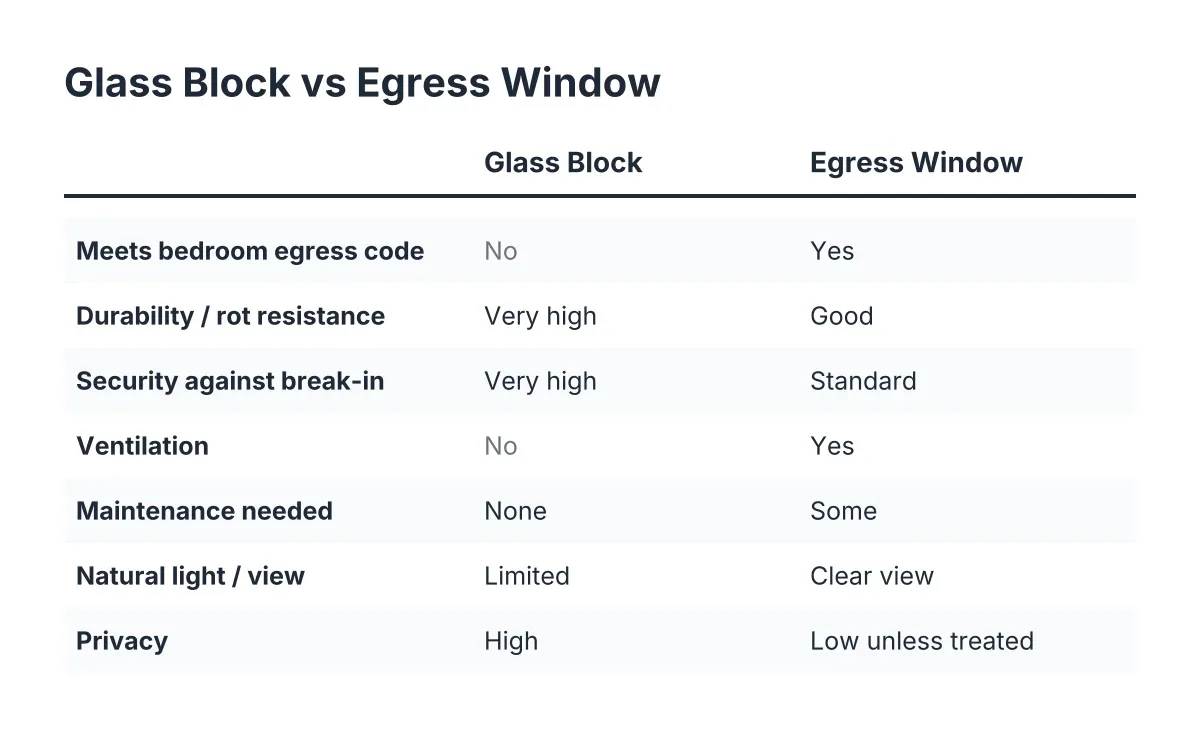
Glass block does not meet egress code, in Minneapolis or anywhere else. An egress window must open so a person can climb out during a fire, and glass block is a fixed, mortared panel that cannot open at all. If the basement room is a bedroom, or you want to sell it as one, glass block disqualifies it no matter how new the panel is.
The size rules make this concrete. According to the City of Minneapolis, each bedroom below the fourth floor needs a window at least 20 inches wide by 24 inches high, with nothing blocking it. The City of Minneapolis rental checklist also specifies that a proper egress window or door must open to the outside. A glass block panel fails both tests. It does not open, and you cannot climb through it.
This is where pre-sale sellers get burned. Say a homeowner in South Minneapolis finished the basement years ago and added a room with a bed, a closet, and a glass block window. The listing calls it a third bedroom. The buyer's inspector calls it a den, because there is no bedroom egress. In that scenario, the seller either drops the bedroom from the listing, which cuts the price, or installs a code-compliant egress window on a tight closing timeline. Neither option is fun, and both were avoidable.
So the first decision rule is simple. If the room is a bedroom, or might ever be sold as one, you need an egress window and a window well, not glass block. If the room is a laundry room, utility space, or storage area, glass block stays on the table. That is when the frost question matters.
How Minnesota Frost Cycles Damage Glass Block Basement Windows
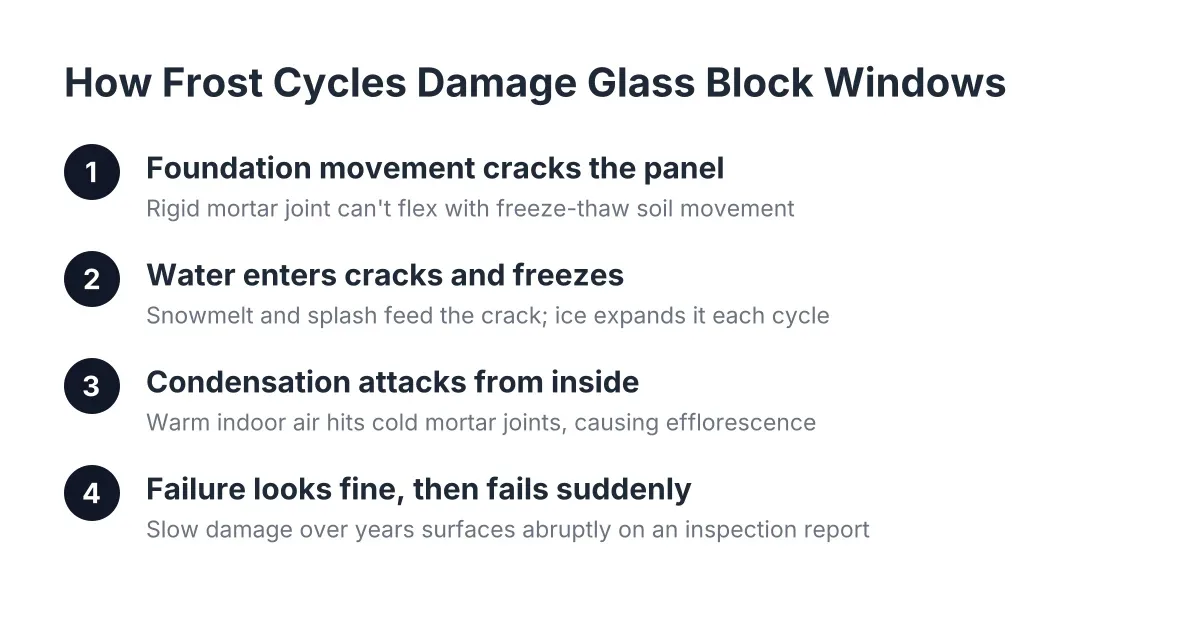
Minnesota frost cycles damage glass block basement windows through movement, moisture, and mortar. The blocks themselves are tough. The mortar joints holding the panel in the foundation opening are not. Minneapolis winters push freeze-thaw cycling through those joints dozens of times a season, and the joints lose that fight over the years.
Here is the mechanism, step by step.
Foundation movement cracks the rigid panel
A glass block panel is rigid. It is essentially a small glass block wall set into your foundation with mortar. Your foundation, however, moves. Minneapolis frost depth runs deep, and the soil around your basement expands as it freezes and settles as it thaws. Wood-frame windows flex with that movement. A mortared block panel cannot. The stress concentrates in the perimeter joint between the panel and the concrete, and hairline cracks open there first.
Water gets into the cracks and freezing makes them worse
Once a hairline crack opens, water finds it. Snowmelt against the foundation, a clogged window well, or splash from a downspout all feed moisture into that joint. When it freezes, the ice expands and widens the crack. Next thaw, more water gets in. Every cycle makes the gap larger. This is the same process that breaks up Minneapolis streets every spring, running in miniature along your window perimeter.
The stakes are not small. According to the Insurance Information Institute, water damage and freezing claims made up nearly 24% of all homeowners insurance claims in 2021, with the average household claim about $12,514 between 2017 and 2021. A failed mortar joint at grade level is exactly the kind of slow leak that feeds those claims.
Condensation attacks from the inside
Glass block insulates better than old single-pane glass, but the mortar joints between blocks are thermal weak points. On a January morning in a heated finished basement, warm indoor air hits those cold joints and condenses. Over the years, that moisture cycles through the interior mortar, and you see it as white efflorescence staining, crumbling joint edges, or a musty smell near the window.
The failure is slow, then sudden
None of this happens in one winter. A well-installed panel with good drainage can look fine for a decade or more. A poorly installed one, set with the wrong mortar or with no expansion allowance, can show perimeter cracking within a few seasons. Either way, the failure mode is the same: cracked joints, water intrusion, and eventually a panel that has to be chiseled out and redone. That removal is messier and more expensive than replacing a framed window, because there is no frame. The whole assembly is mortared into your foundation.
What Frost-Cycle Failure Looks Like on an Inspection Report
Inspectors know where to look. If you are prepping a Minneapolis house for sale in 2026, walk your basement perimeter and check for these before the buyer's inspector does:
- Hairline cracks in the mortar joint where the panel meets the concrete foundation
- White, chalky staining (efflorescence) on interior joints, a sign moisture is moving through
- Crumbling or sandy mortar you can scrape out with a key
- A cracked or fogged individual block, which usually means trapped moisture
- Standing water or debris in the window well outside the panel
- Damp drywall or musty carpet below the window in a finished basement
Any one of these can land on an inspection report as "monitor" or "repair." Several together get written up as active water intrusion, and that phrase gives a buyer real negotiating room. However, catching it early changes the math. Repointing a failing joint before listing is a small line item. Explaining a wet basement wall during a repair addendum negotiation is not.
Where Glass Block Basement Windows Still Make Sense
Glass block basement windows still make sense in non-bedroom spaces where privacy and security matter more than escape. A laundry room, a utility room, a workshop, or a storage area with a small opening at grade is the right home for block windows. In those rooms, code compliance does not require an openable window, and the security benefit is real.
The frost problem does not disappear in those rooms, but it becomes manageable if the installation respects Minnesota conditions. Three things separate a panel that lasts from one that fails:
- Drainage away from the opening. Grade the soil so water runs away from the foundation, keep the window well clear, and extend downspouts. Most frost-cycle failures start with water pooling against the panel.
- The right mortar and joint detail. The perimeter joint needs to accommodate slight movement between the rigid panel and the foundation. A hard, brittle full-mortar perimeter with no allowance is the classic DIY mistake.
- A vented panel where moisture builds. Glass block basement windows with air vents let a laundry room breathe, which cuts interior condensation on the joints.
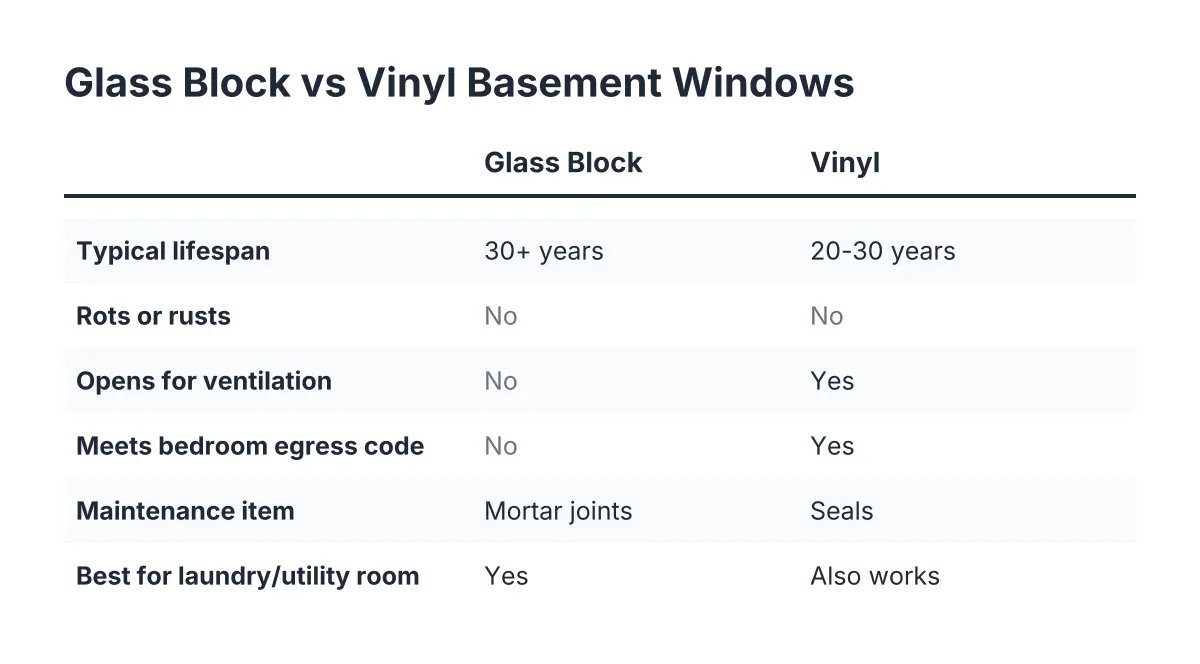
If you weigh glass block vs vinyl basement window options for these rooms, the honest trade-off is this. Vinyl gives you an opening window, easier future replacement, and a frame that flexes with the foundation. Block gives you security and privacy with no hardware to fail. In a walk-out utility room in Northeast Minneapolis, either can be the right call. In a below-grade bedroom, only an egress window is the right call.
Glass Block Window Installation Cost, and Where the Money Actually Goes
Glass block window installation cost varies with panel size, whether the old window and frame must be cut out, and the condition of the surrounding concrete. Pricing also depends on whether you buy pre made glass block windows and install them yourself or hire a local installer to mortar the panel in. There is no single number that fits every basement, which is why a written quote against your actual openings beats any online average.
For comparison, the code-compliant alternative has published national averages. According to HomeAdvisor, installing an egress window costs an average of $4,229, with most homeowners spending between $2,723 and $5,877. Angi puts the nationwide average at $4,244 per window. An egress project costs more than a block panel because it usually involves cutting the foundation opening larger, installing the window and the window well, and grading for drainage.
That gap is exactly why the bedroom question has to come first. Suppose you spend money installing glass block in a basement room, then list the house with that room as a bedroom. The buyer's inspector flags the missing egress, and now you pay for the egress window installation anyway, on a compressed timeline, after already paying for block. You have bought two windows to end up with one. Running the room-use decision before the product decision prevents that double spend.
For a pre-sale fixer, the practical move is to get quotes on both paths for any questionable room: a basement window replacement with block or vinyl, and a full egress upgrade with window well installation. A quote is free, and having both numbers in writing before the buyer's attorney sends a repair addendum keeps the negotiation on your terms.
A Decision Framework for the Pre-Sale Seller
If an inspection report or your realtor has flagged your basement windows, work through these questions in order.
- Is the room a bedroom, or will it be listed as one? If yes, you need an egress window that meets the bedroom egress requirement. Glass block is off the table for that opening. Confirm the opening size against Minneapolis code, and plan for a window well if the sill sits below grade.
- Is the room utility, laundry, or storage? Block windows are a legitimate option here. Focus on drainage and joint detail so the panel survives frost cycles.
- Are existing block panels showing cracks or efflorescence? Get them assessed before listing. Repointing or replacing one panel proactively is cheaper than negotiating a water-intrusion finding.
- Is the timeline tight? Get written quotes on every flagged opening now, even ones you might not fix. Documented numbers give you leverage; guesses give the buyer leverage.
One honest limitation: this article cannot inspect your foundation. Whether a cracked joint is cosmetic or a sign of active water movement, and whether a specific room legally qualifies as a bedroom under Minneapolis code, are judgment calls that need eyes on the actual opening. A local installer who works with Minneapolis soil and frost depth, or a city inspector, should make those calls before you commit money.
The Bottom Line on Glass Block in a Frost State
Glass block is not a bad product. It is a fixed, security-focused panel that belongs in non-bedroom basement rooms, installed with drainage and joint details that respect what Minnesota winters do to rigid assemblies mortared into moving foundations. Used that way, block windows earn their keep for years.
The failures come from using it in the wrong place or installing it as if Minneapolis were Phoenix. A block panel in a room you need to sell as a bedroom fails the code test on day one. A block panel set with a brittle perimeter joint and bad drainage fails the frost test over a decade. Both failures land on an inspection report at the worst possible time, when a closing date is set and every repair item is a negotiation.
Therefore, decide the room's use first, the window type second, and the installation details third. If you are looking at basement bedroom ideas for a finished basement, budget for a real egress window and window well from the start. If you are securing a laundry room window at grade, block is a fine tool. Either way, get the quote in writing before the buyer does the math for you.
If you need basement egress window installation, Minneapolis Window Pros can help.
Prefer to talk it through? Call (612) 482-9787 — a quick call is usually the fastest way to get a straight answer for your situation.