Basement Window Blocks in Minneapolis: Why Older Homes Have Them and What to Do When They Fail
If you own an older house in the Twin Cities, you probably have at least one glass block or old block-style window below grade. Maybe one is cracked, foggy, or leaking, and a home inspector just flagged it. This guide explains basement window blocks in Minneapolis homes: what they are, why so many houses here have them, which failures can be repaired, which ones mean replacement, and how to decide between a hardware store kit and hiring a window installer—including foggy glass block repair. If you are prepping a house for sale, you will also find a straight answer on what buyers and inspectors actually care about.
What Basement Window Blocks Are and Why Minneapolis Homes Use Them
Basement window blocks are thick glass units mortared together inside a basement window opening, replacing an operable window with a fixed, sealed panel. Minneapolis homes use them because they resist break-ins, block drafts, and never rot, which matters in a climate with hard freezes and in neighborhoods full of pre-1990 foundations with failing original windows.
Here is the backstory. Most older Minneapolis houses were built with small steel or wood basement windows set low in the foundation. Many of those steel frames were cast directly into the concrete when the house was built. They were durable, but once the glass broke or the frame rusted, they were hard to remove cleanly.
Glass block became the common fix. Instead of fighting the old frame, an installer could knock out the sash, mortar in a panel of block windows, and seal the opening for good. The result was a window that let in light, kept out water and intruders, and needed no paint or maintenance.
That is why you see so many of them on alleys and side yards across South Minneapolis, Northeast, and the first-ring suburbs. They solved a real problem. But they are not permanent, and when they fail, the fix depends on how they were built and what the room behind them is used for.
Identifying Foggy Glass Block Repair and Other Failure Modes
Block windows fail in predictable ways, and the failure mode tells you whether repair is realistic. The glass itself rarely breaks on its own; the weak points are the mortar joints, the perimeter seal, and the hollow centers of each block.
Here are the four failures we see most in older Minneapolis basements:
- Cracked mortar joints. Freeze-thaw cycles work moisture into the joints between blocks. Over decades, the mortar crumbles, and the panel loosens in the opening.
- Fogged or wet blocks. Each glass block is a sealed hollow unit. When the seal fails, moisture gets inside and condenses. A foggy block cannot be dried out or resealed; the fog is permanent.
- Cracked blocks. Foundation settling, an errant lawnmower rock, or ice pressure can crack a single block. One cracked block in a mortared panel is not a swap-one-out repair, because every block is bonded to its neighbors.
- Perimeter leaks. The joint between the block panel and the concrete foundation fails, and water finds its way in during spring melt or heavy rain.
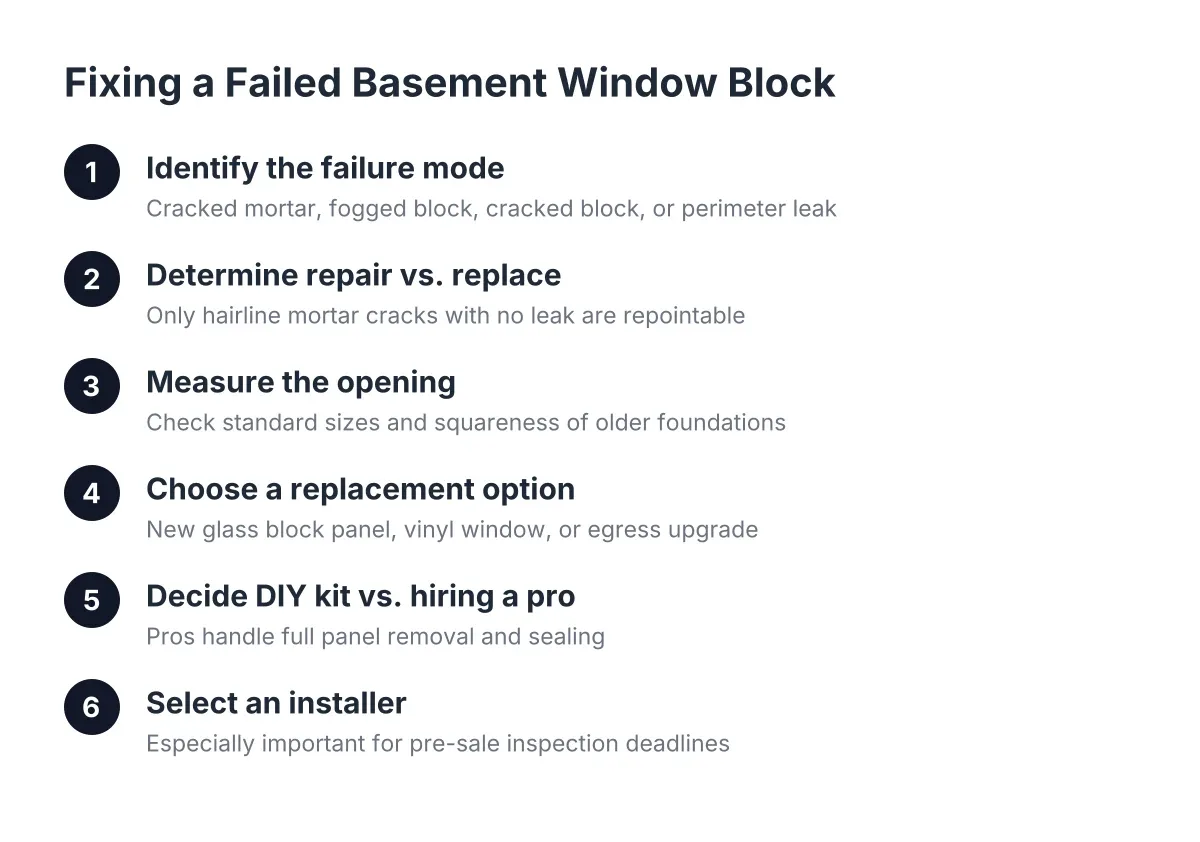
A hairline crack in one joint with no water intrusion can sometimes be repointed with mortar or sealed with masonry caulk. That is a legitimate repair, and a careful homeowner can do it. Everything else on the list above points toward replacement, because the panel is a single bonded unit.
Can You Repair a Foggy or Cracked Block Window?
A foggy glass block window cannot be fixed; the fog means the block's internal seal has failed, and the moisture is trapped permanently inside the glass. Cracked mortar joints can be repointed if the panel is still solid. A cracked glass block, however, means replacing the whole panel, since the blocks are mortared into one unit. When a foggy glass block repair is what you are considering, the reality is that the entire panel must be replaced instead.
This is the part hardware store kits do not explain. The DIY kits sell you blocks, spacers, and mortar or silicone, which works fine for building a new panel in a clean opening. They do not help you extract one failed block from the middle of a 40-year-old mortared panel without cracking its neighbors. In practice, nobody does that repair; the panel comes out as a unit.
Therefore, the real decision is not repair versus replace. It is what to replace the failed panel with, and that depends on the room behind it.
Standard Basement Window Block Sizes in Minneapolis Homes
Most Minneapolis basement window openings fall into a handful of standard widths, typically 32 inches, and heights between 14 and 24 inches, which is why glass block panels here are usually built from 8-inch blocks in a 4-wide by 2-or-3-high grid. Knowing your opening size tells you whether a stock kit fits or whether you need a built-to-size panel.
Individual glass blocks come in standard face sizes, most commonly 6 by 6 inches and 8 by 8 inches, in thicknesses around 3 to 4 inches. An installer measures the masonry opening, then plans a block layout that fills it with mortar joints making up the difference. For example, a 32-inch wide by 18-inch tall opening might take four 8-inch blocks across and two high, with joints absorbing the remainder.
However, measure before you buy anything. Older foundations are not precise. Openings in poured or block foundations from the 1950s and 1960s can be out of square by a half inch or more, and the wood you see around an old frame may not be real dimensional lumber at all. In some houses it is the original form board that concrete was poured against, and it will not come out the way framing lumber would.
If your opening does not match a stock panel size, you have two options. A supplier can build a custom mortared panel to your measurements, or an installer can adjust the opening. Padding a slightly oversized opening with pressure-treated lumber to hit an exact fit is standard practice, and it is also how installers set up openings for vinyl replacement windows.
Replacement Options: New Blocks, Vinyl Windows, or an Egress Upgrade
When a block panel fails, you have three realistic paths. Each fits a different basement and a different plan for the house.
Option 1: New glass block panel
Glass block window replacement makes sense when the basement is unfinished storage or laundry space and you liked what the old panel did. New blocks restore security, light, and a sealed opening, often with a vent insert so the room can breathe. It is the lowest-disruption option; the old panel comes out, the opening gets cleaned up, and a new panel goes in, usually in a few hours per window.
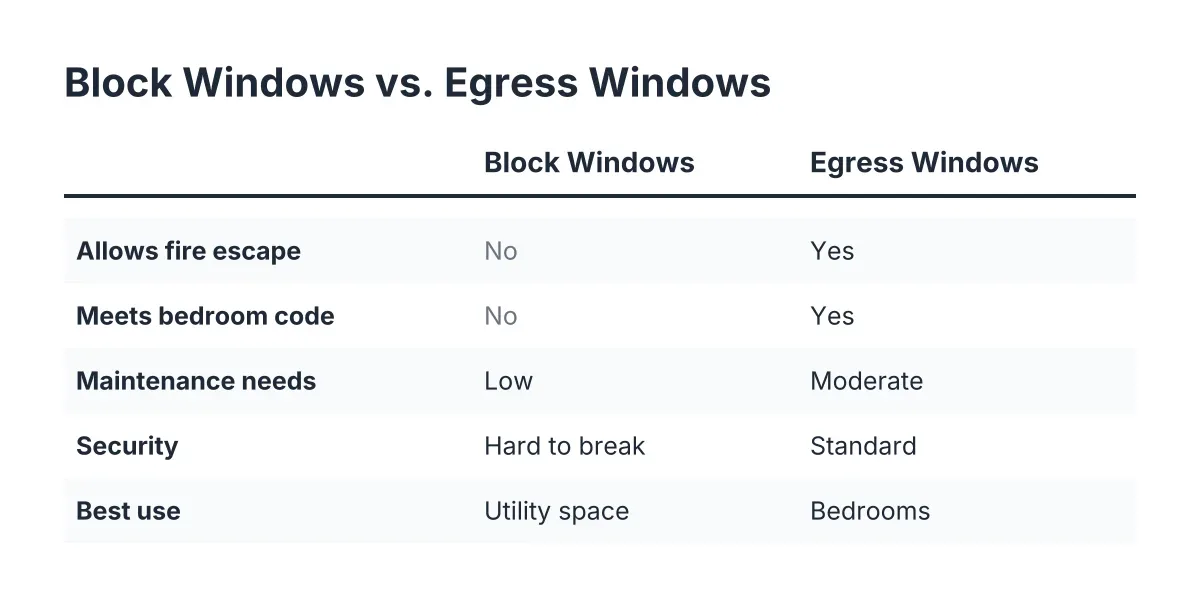
The trade-off is permanence. A mortared panel does not open, so it provides no escape route and limited airflow. If there is any chance the room becomes a bedroom, blocks close off that option.
Option 2: Vinyl basement window replacement
A sealed, insulated vinyl window, either a hopper or a small slider, fits the same opening and gives you airflow, better insulation than single-pane glass, and a window you can clean. For a finished basement used as a family room or office, this is usually the better call. Modern basement window installation also looks better from the curb than a mismatched block panel, which matters when photos go on a listing.
The trade-off is security and cost. An operable window is easier to force than a mortared panel, though locks and well covers close most of that gap.
Option 3: Egress window and window well
If the basement room is, or will be marketed as, a bedroom, neither blocks nor a small vinyl window satisfies code. Minneapolis code requires each bedroom below the fourth floor to have a window at least 20 inches wide by 24 inches high with nothing blocking it, according to the City of Minneapolis. The broader IRC egress standard calls for a minimum net clear opening of 5.7 square feet, with a window well projecting at least 36 inches from the house, according to HomeAdvisor.
That means cutting the foundation to enlarge the opening and installing a window well. It is the most involved option. Cutting the foundation wall is the critical phase, since the cut has to be precise enough for the new window to fit and seal without weakening the wall. This is not a DIY project, and it is the specialty work a local installer should be able to explain in detail, including Minneapolis frost depth and soil conditions around the well.
For cost context, adding an egress window and well runs about $3,900 on average, according to Angi. Window well replacement alone averages $2,200, with most homeowners spending between $1,800 and $3,000, according to HomeAdvisor. Your project will vary, which is why a written quote against your actual openings matters more than national averages.
DIY Kits vs. Hiring a Pro for Basement Window Blocks in Minneapolis
A capable DIY homeowner can mortar a new glass block panel into a clean, square, unfinished-basement opening; everything beyond that is pro work. Removing steel frames cast into concrete, correcting out-of-square openings, replacing panels in a finished basement, and any foundation cutting for egress should go to a window installer.
The good news for DIYers: an unfinished basement window is a forgiving place to learn. Imperfect joints are rarely visible, and the only hard requirement is that water stays out. If you can lay blocks level, strike clean joints, and seal the perimeter against the concrete, a kit panel in a sound opening is achievable over a weekend.
The failure points are predictable, though. Old steel frames cast into the foundation do not pry out; they have to be cut, and the surrounding concrete often needs patching. Water management is the other trap. The bottom of the opening needs to shed water out, not in, and a bead of caulk plus a well cover over any below-grade opening keeps meltwater out of the basement. Skip that step in a Minneapolis spring and you will find out why it matters.
Call a pro now, not later, if you see any of these:
- Water staining or active leaking around the panel after rain or snowmelt.
- A panel that moves when you push on it, meaning the mortar bond to the foundation has failed.
- Cracks in the foundation radiating from the window corners.
- Any plan to make the room a legal bedroom, which triggers the bedroom egress requirement.
One honest limitation: if your foundation shows settling cracks near the window openings, get the foundation assessed before putting money into windows. New blocks mortared into a moving wall will crack again.
What the Work Includes When You Hire It Out
A complete block window replacement job covers more than setting new glass. When you compare quotes, check that each one includes the same scope, because this is where quotes that look far apart turn out to be measuring different jobs.
A thorough quote should cover:
- Removal and disposal of the old panel or steel frame, including cutting frames cast into the concrete.
- Cleanup and prep of the masonry opening, with patching of spalled or damaged concrete.
- The new panel or window, with vent insert if you want airflow.
- Mortar or silicone setting, perimeter sealing, and exterior caulking.
- Interior finish where the basement is finished, or a clear note that trim repair is excluded.
Items that are usually extra: window well installation or replacement, well covers, enlarging an opening, and any foundation repair uncovered during removal. Ask about each up front.
Timeline-wise, straight block or vinyl swaps in existing openings are typically done in a day for a few windows. Egress cuts take longer because of excavation, concrete cutting, and the window well. Lead times stretch in spring and early summer when the pre-listing rush hits, so if a closing date is driving your schedule, get measured early.
A Pre-Sale Scenario: The Inspection Flag With a Closing Date
Suppose a homeowner in the Longfellow neighborhood is three weeks from closing. The buyer's inspection report flags two foggy glass block windows and one cracked panel on the alley side, and the buyer's agent sends a repair addendum. The seller has no idea whether this is a $400 problem or a $4,000 problem, and every day of delay gives the buyer room to renegotiate.
In that scenario, the fastest clean resolution is usually like-for-like glass block window replacement. The basement is unfinished, no bedroom is involved, so no egress question applies, and three new sealed panels resolve the inspection items exactly as written. A written, itemized quote does double duty: it fixes the problem, and it documents a fair number if the seller instead credits the buyer at closing rather than doing the work.
What that seller should not do is let a contractor upsell an egress conversion that the inspection never asked for, or accept a one-line quote with no scope. The addendum defines the job. Match it, paper it, and move on to closing.
Choosing an Installer for Basement Window Blocks in Minneapolis
Choose a local installer who measures your actual openings, explains whether blocks, a vinyl window, or an egress upgrade fits your basement's use, and puts the full scope in a written quote. In Minneapolis, they should also speak specifically to frost, drainage, and window wells, not quote from a script.
Searching glass block windows near me will surface plenty of names across the Twin Cities. Three questions separate the ones worth your time:
- Will you measure on site before quoting? Openings in older foundations vary, and a quote built on assumed standard sizes gets revised later, usually upward.
- What exactly is included, and what is extra? You want removal, disposal, prep, sealing, and cleanup itemized, with wells and concrete work called out separately.
- What would you install here, and why? A good installer asks how you use the basement before recommending blocks versus an operable window. If the answer does not depend on your answer, keep looking.
A fair quote is written, itemized by opening, and specific about materials. Pricing varies by project, so treat any number given over the phone without measurements as a placeholder, not a commitment.
Getting a Straight Answer on Your Basement Windows
Block windows earned their place in Minneapolis basements, and in an unfinished basement they are still a sound choice in 2026. But a foggy or cracked panel is a replacement, not a repair, and the right replacement depends on what the room is for. Storage space points to new blocks or a sealed vinyl unit. A finished family room points to an operable window. A bedroom points to a code-compliant egress window and well, full stop.
If an inspector flagged your basement windows or you are planning a basement project, the next step is simple: get your openings measured and get a written quote. We install and replace basement windows across Minneapolis, from single block panels to full egress windows and window wells, and quotes are free. Reach out, tell us what the inspection report or your remodel plan says, and we will give you a plain answer on what the work involves and what it will take to get it done on your timeline.
If you need basement egress window installation, Minneapolis Window Pros can help.
Prefer to talk it through? Call (612) 482-9787 — a quick call is usually the fastest way to get a straight answer for your situation.