Casement vs. Double-Hung Basement Windows: Which Opens Better Underground
Water in the window well, a cracked frame, or a rotted sill forces the same question on every Minneapolis homeowner: repair the old window, or replace it, and with what? When you compare casement versus double-hung egress windows for basements, the answer usually comes down to one thing: how each one behaves below grade, where clearance is tight and water is the enemy. This guide walks through when a repair won't cut it, then compares both window styles on the criteria that matter in a basement, so you can make the call without guessing.
A Contractor's Checklist: When Repair Won't Cut It
Before you compare window styles, decide whether replacement is even the right move. Some basement windows can be patched and resealed. Others are past saving, and money spent on a repair just delays the replacement bill.
Here is the checklist a working installer runs through on a first visit:
- Rot in the frame or sill. Soft wood at the bottom of the frame means water has been getting behind the window for a while. Sealing the surface does not fix wood that has already failed.
- Rusted steel frames set in concrete. Many older Minneapolis basements have steel-framed windows cast directly into the foundation. Once these rust through, there is no practical repair; the frame has to come out.
- Water entering during rain or snowmelt. If water comes in through the window itself, not just the well, the seal between frame and foundation has failed. A bead of caulk is a band-aid, not a fix.
- Fogged or broken double-pane glass. Fogging means the seal between panes is gone. On a small basement window, the glass repair often costs close to what a new unit does.
- The room is becoming a bedroom. A finished basement bedroom triggers the bedroom egress requirement. No repair makes an undersized window code-compliant; the opening has to be enlarged.
- The window will not open or latch. A basement window that is painted shut, warped, or missing hardware fails its most basic job: ventilation and, for egress windows, escape.
Two or more items on this list, and replacement is the sound call. That is when the casement versus double-hung question actually matters.
Why Window Style Matters More Below Grade
Above grade, casement versus double-hung is mostly a style preference. Below grade, it is a functional decision. Basement windows sit in a window well, often close to the well wall, with soil and snow pressing in around them. Three things change underground:
First, clearance is limited. A window well only projects so far from the house, and anything the window does when it opens has to happen inside that space.
Second, water exposure is constant. Rain runs down the foundation, snowmelt pools in the well, and any gap in the seal becomes a leak path. If you have ever watched water pour in through a window well during a July downpour, you know the stakes.
Third, code compliance is stricter. If the window serves a bedroom, it must meet egress sizing. According to HomeAdvisor, IRC egress code requires a minimum net clear opening of 5.7 square feet, plus a window well that projects at least 36 inches from the house with a nine-square-foot footprint.
How Casement and Double-Hung Egress Windows Perform Underground
A casement window is hinged on one side and swings outward like a door, usually with a crank. In a basement, this design has one big advantage: when it opens, the entire window opening is clear. Nothing blocks the top or bottom half.
That matters most for egress. To hit 5.7 square feet of net clear opening, a casement window can be smaller overall than a double-hung, because the full frame opens. In a Minneapolis foundation wall, where every inch of concrete cutting adds work, a smaller rough opening is a real benefit.
Casements also seal tighter. The sash presses against the frame when you crank it shut, which compresses the weatherstripping. In a climate with a real frost depth and long heating season, that tighter seal cuts drafts along the floor of a finished basement.
The trade-offs are physical. The sash swings out into the window well, so the well must be deep enough for the window to open fully. A shallow or debris-filled well can block the swing. Crank hardware is also the most common failure point; grit from the well works into the mechanism over the years.
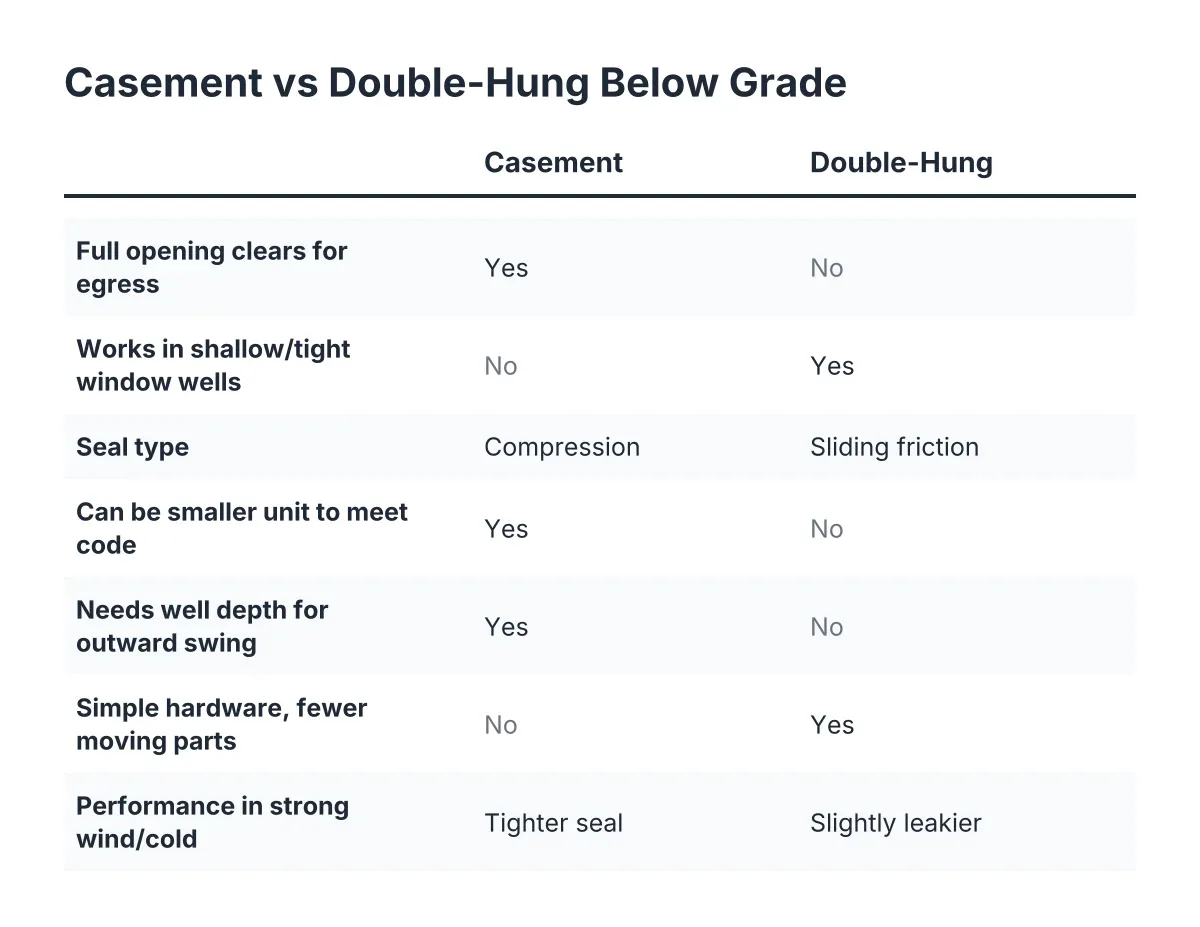
Casement below grade, in short:
- Full opening clears for egress, so smaller units can meet code
- Compression seal handles Minnesota wind and cold well
- Needs enough well depth for the outward swing
- Crank hardware wears and can fail with grit exposure
How Double-Hung Basement Windows Perform Underground
A double-hung window has two sashes that slide up and down inside the frame. Nothing swings outward, which is its main advantage in a tight window well. If your existing well is shallow, or a galvanized well sits close to the frame, a double-hung opens fully without touching the well wall.
However, only half the window opens at a time. The top sash or the bottom sash slides, but the other half of the frame stays blocked. For egress, that means a double-hung must be about twice the size of a casement to deliver the same 5.7 square feet of clear opening. In a short basement wall, there often is not enough height to make that work.
Double-hungs also seal by sliding friction rather than compression. They perform fine, but in a hard January wind they typically let through more air than a well-latched casement. On the plus side, both sashes tilt in on most models, so you can clean the outside glass from inside the basement instead of climbing into the well.
Double-hung below grade, in short:
- No outward swing, so it works in shallow or tight wells
- Simple hardware with fewer moving parts to fail
- Only half the opening clears, which makes egress sizing hard
- Slightly leakier seal in strong wind and deep cold
Casement vs. Double-Hung Basement Windows, Side by Side
Here is the direct comparison on the criteria that decide most Minneapolis projects:
- Egress compliance: Casement wins. The full clear opening means a casement can meet the bedroom egress requirement in a smaller rough opening. A double-hung usually cannot meet egress in a standard short basement wall.
- Tight window wells: Double-hung wins. No swing means no clearance problem, even in older, shallow wells.
- Air sealing for winter: Casement wins by a margin. The compression seal fights drafts better through a Minneapolis winter.
- Hardware durability: Double-hung wins. Sliding sashes have less to break than crank mechanisms exposed to well grit.
- Cleaning and upkeep: Double-hung wins. Tilt-in sashes beat leaning into a window well with a squeegee.
- Ventilation: Casement wins. It can catch and direct breeze into the basement; a double-hung only opens half its area.
Cost between the two styles is usually not the deciding factor; the concrete work, well, and drainage drive the project total more than the unit style. For reference, Angi reports that egress window installation averages $4,244 nationwide, and HomeAdvisor puts window well replacement at an average of $2,200. Your project will vary, which is why a real quote beats a national average.
What the Replacement Process Looks Like
A straightforward basement window replacement, same size and no concrete cutting, follows a predictable sequence. Suppose a homeowner in South Minneapolis has a rusted steel-frame window that leaked during spring snowmelt. A typical crew handles it like this:
- Remove the old unit. Steel frames cast into the foundation take cutting and prying; wood frames come out faster.
- Prep the opening. The concrete opening is usually a few inches larger than the window, so the crew pads it out with pressure-treated lumber to hit the exact rough opening.
- Flash and slope the sill. The bottom board gets a slight outward slope so any water that sneaks behind the window drains away from the wall, not into it.
- Set the new window. A basement window insert replacement is sized slightly smaller than the rough opening so the crew can shim it plumb and level. A window that is out of level leaks air now and water later.
- Insulate and seal. Spray foam fills the gaps, and exterior sealant closes the joint between frame and foundation.
- Address the well and grading. If water was the original problem, the fix is not done until the window well drains and the soil grades away from the house.
That same-size swap often finishes in a day. If the project involves enlarging the opening for egress, add concrete cutting, excavation, window well installation, and a drain, which stretches the timeline to two or three days depending on soil and access.
One honest limitation: if water is entering through the foundation wall itself, not the window or well, a new window will not stop it. That is a drainage or waterproofing problem, and it is worth having someone look at the whole picture before you spend money on glass.
How to Choose
Start with code, then clearance, then climate. If the window serves a bedroom or a future bedroom in your finished basement, choose a casement; it is the practical way to meet egress sizing in a short foundation wall as of the 2026 code cycle. If the window is a small utility or laundry-room unit in a shallow well, a double-hung avoids the swing-clearance problem and keeps hardware simple. Additionally, if neither constraint applies, let winter decide; the casement's tighter seal earns its keep from November through March.
For rooms where you never need the window to open, glass block is a third path worth knowing about; block windows seal permanently and shrug off window well moisture, though they give up ventilation and egress entirely.
The casement versus double-hung basement windows decision gets easier once someone measures your actual opening, well depth, and drainage on site. A local installer who works Minneapolis foundations can tell you in one visit whether your wall height allows egress, whether your well clears a casement swing, and what the water in your well is actually telling you.
If you need basement egress window installation, Minneapolis Window Pros can help.
Prefer to talk it through? Call (612) 482-9787 — a quick call is usually the fastest way to get a straight answer for your situation.