Casement vs. Double-Hung Windows for Small Basement Openings in Minneapolis
If you own an older Minneapolis house, your basement window openings probably do not match anything on the shelf at the hardware store. That is the first thing most comparison articles skip. The casement vs double-hung basement window question is not just about style; it is about which frame can actually fit, seal, and possibly meet code in a shallow opening that was poured into your foundation 70 or 80 years ago. This article walks through both styles side by side, with the sizing realities that store kits and big regional contractors tend to gloss over.
Here is the short version. Casement windows crank open like a door and give you the largest clear opening for a given frame size. Double-hung windows slide up and down, so half the frame is always blocked by glass. In a short, wide basement opening, that difference decides whether a window can ever count for egress. But there is more to it, so let us take it one criterion at a time.
Why Small Basement Openings Change the Comparison
Most casement versus double-hung articles assume a full-size wall opening in a living room. Basements are different. The typical old Minneapolis basement window sits high on the foundation wall, and the opening is often wider than it is tall, something like 32 by 16 inches or 30 by 20 inches.
Many of these openings hold steel-framed windows cast directly into the concrete. They were durable when installed, but they are stubborn to remove during a basement window replacement, and their sizes rarely match standard window sizes sold today. Store kits list common basement windows sizes, but "common" assumed newer construction. Your 1948 bungalow did not get that memo.
Therefore, the real comparison is not casement versus double-hung in the abstract. It is which style performs better when the opening is short, wide, close to grade, and non-standard. That framing changes the winner in several categories.
Casement vs. Double-Hung in a Small Basement: Side by Side
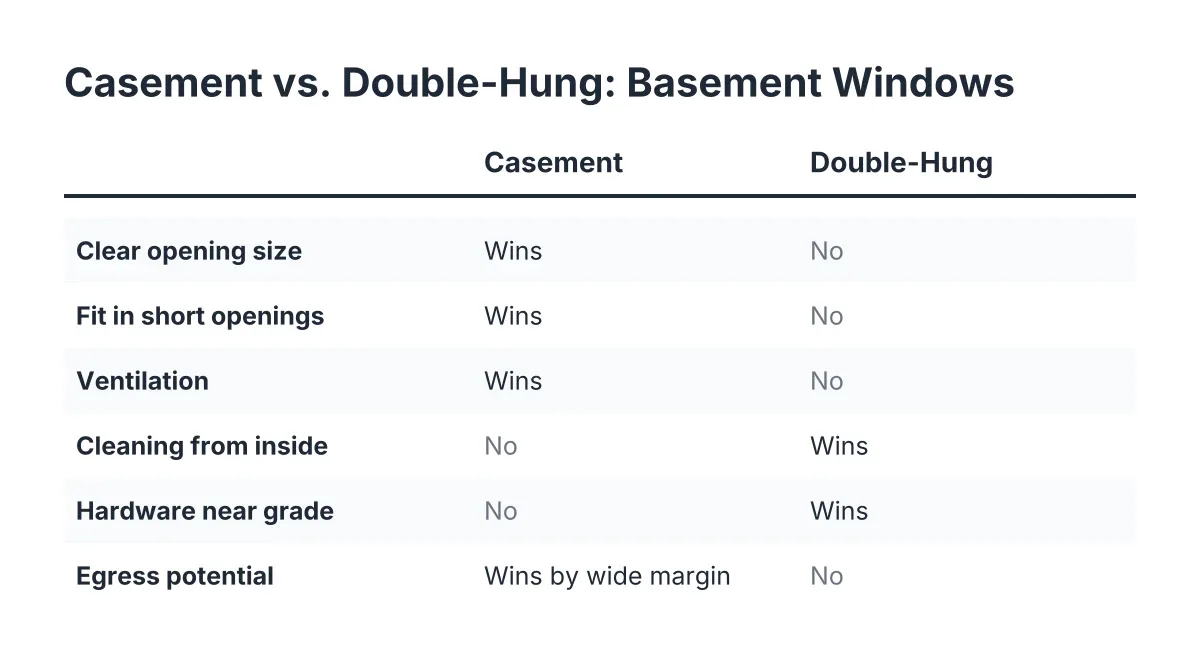
Before the detailed breakdown, here is the quick scorecard for small basement use:
- Clear opening size: Casement wins. The whole sash swings out of the way.
- Fit in short openings: Casement wins. Double-hung windows need height to work.
- Ventilation: Casement wins. It opens fully and can catch a crosswind.
- Cleaning from inside: Double-hung wins in theory; in a basement, it is close.
- Hardware near grade: Double-hung wins. No crank arm swinging into a window well.
- Egress potential: Casement, by a wide margin.
Now the detail behind each of those calls.
Clear Opening: The Number That Decides Egress
A casement window opens its entire sash, so the clear opening is close to the full frame size minus the frame itself. A double-hung window only ever opens half its height, because one sash always blocks the other. In a 40-inch-tall opening, that costs you about 20 inches of escape route.
That math matters if the basement room will ever be a bedroom. According to HomeAdvisor, IRC egress code requires a minimum net clear opening of 5.7 square feet, plus a window well projecting at least 36 inches with a nine-square-foot footprint. In addition, the City of Minneapolis requires each bedroom below the fourth floor to have a window at least 20 inches wide by 24 inches high, with nothing blocking it.
A small double-hung window in a typical old basement opening will not hit those numbers. Ever. A casement of the same frame size might, and if the opening is enlarged for a full egress window, casements are the standard choice for exactly this reason. The egress rules exist to give someone in the basement a real escape route in a fire, which is the whole point of enlarging these openings.
Fit: What Actually Goes Into a Short, Wide Opening
Casements handle short, wide openings well because the sash swings sideways. Double-hung windows fight a short opening; each sash in a 16-inch-tall frame would be about 8 inches of glass, which is nearly useless for light or air.
This is where the hardware store kit falls apart for a lot of Minneapolis homeowners. The kit assumes your rough opening matches a listed size. In practice, installers often treat the concrete opening as a few inches oversized, then pad it with pressure-treated lumber to reach the exact rough opening the new window needs. The replacement window itself should run slightly smaller than the opening in both directions so there is room to shim it plumb and level.
For example, suppose a homeowner in Northeast Minneapolis measures a 31.5 by 17 inch opening in the block. No stocked double-hung comes close. A stocked casement or hopper might get within an inch with pressure-treated padding, or a custom-sized unit closes the gap exactly. That padding-and-shimming step is the part no kit label explains.
Ventilation and Light
Casements win ventilation outright. The full sash opens, and the projecting sash can catch a breeze and direct it inside, which helps a finished basement that runs damp in a Minnesota summer. Double-hungs move air through half their area at best, and in a small basement frame that half is tiny.
Light is roughly a tie for the same frame size, though double-hung windows carry a meeting rail across the middle that interrupts the glass. In a window this small, every square inch of glass counts.
Hardware, Wells, and Winter
Here double-hung windows get their points back. A casement cranks outward, so if the window sits below grade inside a window well, the sash swings into the well space. The well must be deep enough for the sash to clear, and the crank hardware sits in the dampest air in the house. Crank mechanisms are also the most common failure point on casements; a seized or stripped operator turns an escape window into a stuck one.
Double-hung windows have no projecting parts. They slide inside their own frame, shrug off a shallow well, and their simpler hardware tolerates humidity better. Tilt-in sashes also make cleaning easier, although on a basement window you can usually reach the exterior glass from the yard or the well anyway.
One more honest note on casements: their compression seal, where the sash pulls tight against the frame, generally seals better against air leakage than the sliding seals on a double-hung. In a Minneapolis January, that difference shows up on the cold-air draft you feel at the sill.
What a Casement or Double-Hung Small Basement Install Costs
For a straight swap into an existing small opening, the window unit and installation together typically land in the high hundreds to low thousands per window, depending on size, material, and whether the old steel frame has to be cut out. That is an illustrative range, not a quote; small basement window cost varies with every foundation. Custom sizing adds cost but often less than homeowners fear, and it beats forcing a stock unit into an opening it does not fit.
Enlarging the opening for a code-compliant egress window is a different project entirely. It means saw-cutting the foundation, installing a window well, and grading for drainage. According to Angi, egress window installation averages $4,244 nationwide, with most homeowners spending between $2,723 and $5,898 per window. If the well itself is the failing part, HomeAdvisor puts window well replacement at an average of $2,200.
However, the style choice barely moves these numbers. When comparing casement vs double-hung basement options, both casement and double-hung units of similar size and material price out close to each other. The cost drivers are the concrete work, the window well installation, and whether your opening is standard or custom. As of 2026, that is still where the money goes.
Where DIY Fits in the Casement vs. Double-Hung Small Basement Decision
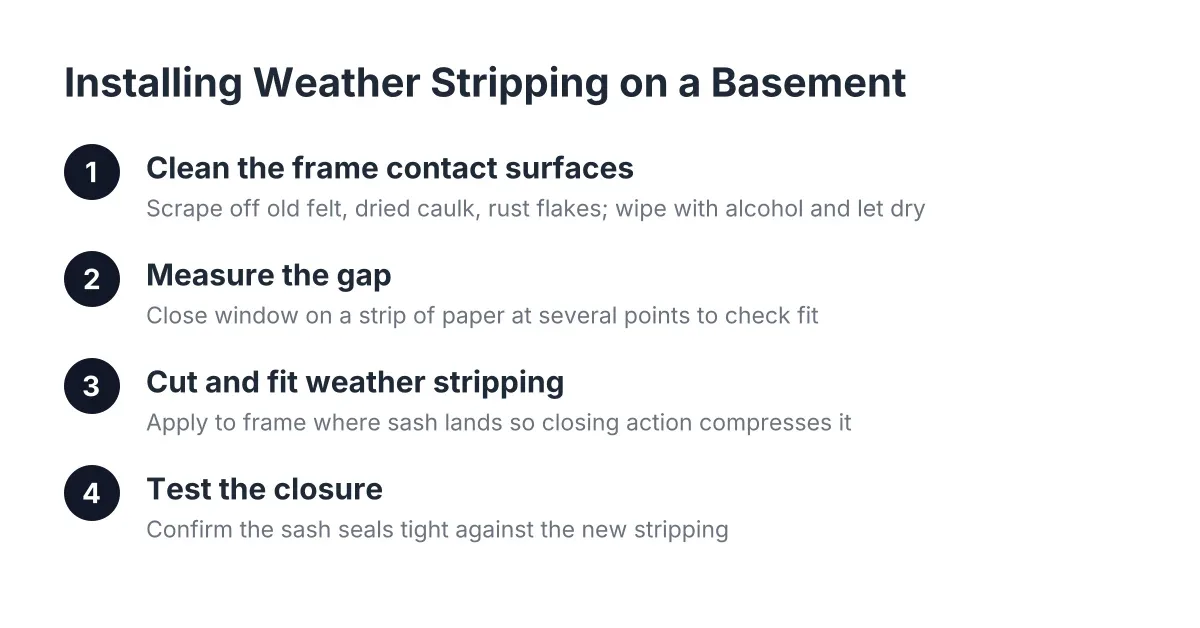
A same-size swap is one of the more forgiving projects for a handy homeowner. The finish work hides behind trim in a basement, and the single functional requirement is that water stays out. If you can measure carefully, shim a frame plumb, slope the sill board slightly outward so water drains away from the wall, and flash the bottom of the opening, a weekend swap of small basement windows is realistic. Glass block is another DIY-friendly route for openings that only need light and privacy, since block windows mortar into the opening without any operating hardware.
Cutting concrete is a different animal. Enlarging a foundation opening is the highest-risk step in the whole job; an imprecise cut can compromise the wall or leave a gap that never seals right. Egress projects also involve permits and inspection for code compliance, and a bedroom that fails the egress requirement can stall a refinance or a sale. For anything that involves cutting the foundation, digging a window well, or meeting the bedroom egress requirement, bring in a local installer and get a free quote before you rent a concrete saw.
Also worth naming: even a well-chosen window will not make every basement feel open. Some people find below-grade rooms confined no matter how much glass you add, so set expectations before you finish the space.
Do Not Forget the Third Option: Hopper Windows
Basement hopper windows tilt inward from a hinge at the bottom, and they are the traditional answer for short, wide basement openings. They vent well, seal with compression like a casement, and have no exterior swing to conflict with a window well. For a utility area, laundry room, or workshop where egress is not required, a hopper often beats both styles in this comparison.
Their weakness is the same as the double-hung's: the clear opening will not satisfy egress in a small frame. Treat hoppers as the practical pick for non-bedroom spaces and casements as the pick where code is in play.
How to Choose
The decision between casement vs double-hung basement windows comes down to three questions:
- Will this room ever be a bedroom? If yes, plan for egress. That points to a casement, and likely an enlarged opening with a window well. Check the numbers against Minneapolis code before buying anything.
- How tall is your opening? Under about 24 inches of height, a double-hung is impractical. Choose a casement or a hopper, or glass block if you only need light.
- What is the well situation? A shallow or tight window well argues for a hopper or double-hung; a properly sized well clears the way for a casement.
Measure your opening in three places on each side, take the smallest numbers, and compare them against listed basement windows sizes before assuming you need custom. If the room needs to meet the bedroom egress requirement, or the project involves cutting concrete, get a straight answer from a local installer who works in Minneapolis foundations and frost conditions. The style choice is the easy part once you know what your opening can actually hold.
If you need basement egress window installation, Minneapolis Window Pros can help.
Prefer to talk it through? Call (612) 482-9787 — a quick call is usually the fastest way to get a straight answer for your situation.