What to Look For in a Window Well Installation Quote in Minneapolis
If a home inspector just flagged your basement windows and the buyer wants them fixed before closing, you need quotes fast, and you need to know which ones are legitimate. Here is how to look at window well installation quotes the way a careful contractor would: check the material, the sizing, the drainage plan, and how the installer handles Minneapolis soil and frost depth. A quote that skips any of those items is a quote you cannot compare against the others.
This guide walks through the review step by step. By the end, you will know which line items matter, which numbers to verify, and which questions separate a solid local installer from a regional outfit quoting from a script.
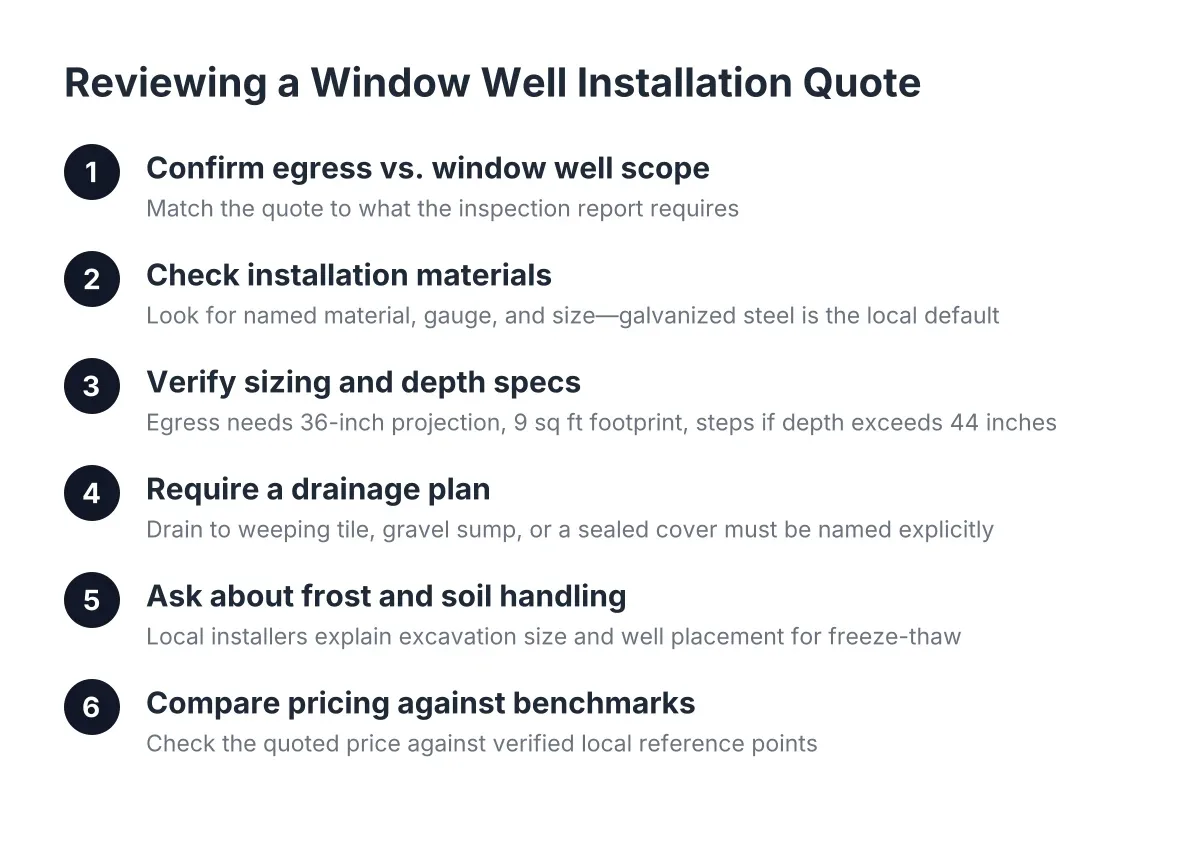
Step 1: Confirm Whether You Need Egress or Just a Window Well
Start by matching the quote to what your inspection report actually says. A basic window well holds back soil around a basement window. An egress window and well must meet code so a person can escape in a fire. These are different jobs at different prices, and sellers get burned when a contractor quotes one while the buyer expects the other.
If the basement has a bedroom, or the buyer plans to finish one, the bedroom egress requirement applies. According to HomeAdvisor, IRC egress code calls for a well that projects at least 36 inches from the house with a nine square foot footprint, plus a window with a minimum net clear opening of 5.7 square feet. Most pre-1990 Minneapolis basements with small block windows do not meet that without cutting the foundation.
Therefore, read the repair addendum closely. If it says "repair or replace basement windows," a basement window replacement with a new well may satisfy it. If it says "bring to egress code," the scope is larger. Get that answer in writing before you compare quotes, because a cheap quote for the wrong scope helps no one.
Step 2: Assessing Window Well Installation Materials in Your Quote
Next, check what the well itself is made of. Every quote should name a material, a gauge or thickness, and a size. If it just says "install window well," ask for specifics.
The common options in 2026 break down like this:
- Galvanized steel (corrugated): The workhorse for Minneapolis. Galvanized egress window wells resist rust, handle frost pressure from clay soil, and bolt directly to the foundation. Most code-compliant egress wells here are galvanized.
- Plastic or composite: Lighter and sometimes molded with built-in steps. Quality varies widely; thin-walled units can bow or crack when frozen soil pushes against them.
- Timber: Looks good in photos, but wood in contact with wet Minneapolis clay has a shorter life than steel, even when pressure-treated.
- Concrete or masonry: Durable but expensive, and usually overkill for a pre-sale fix on a tight closing timeline.
People sometimes frame this as corrugated versus galvanized, but that is a false choice; most galvanized wells are corrugated. The real comparison is galvanized steel against plastic and timber. For an inspection fix that needs to hold up through the buyer's own future inspections, galvanized steel is the safe default.
Sizing and Installation Depth Specs for Your Window Well Quote
Size matters as much as material. The well must extend below the bottom of the window frame and project far enough for the window to open fully. For egress, that means the 36-inch projection and nine square foot footprint noted above, plus a ladder or steps if the window well depth exceeds 44 inches.
A quote that lists an exact well model and dimensions tells you the installer measured. A quote with no dimensions tells you they guessed.
Step 3: Make Sure the Quote Includes a Drainage Plan
This is where weak quotes fall apart. A window well is a hole next to your foundation; without drainage, it becomes a bathtub that drains into your basement. Any serious window well installation quote spells out how water leaves the well.
Look for one of these approaches, named explicitly:
- A drain tied to the weeping tile. A drainage pipe runs from the well's gravel base down to the drain tile system below the basement floor. This is the most reliable setup for Minneapolis clay, which sheds water slowly.
- A gravel sump under the well. A deep gravel column lets water soak away. This works in sandier pockets of the metro but can fail in heavy clay.
- A solid, sealed cover. When no drain exists under the well, a solid cover keeps rain and snowmelt out in the first place. The quote should include the cover and a bead of caulk around its edge.
In addition, the quote should mention sealing where the well meets the house. Waterproof sealant along those edges keeps dirt and water from working behind the well or under the window. If drainage and sealing do not appear anywhere in the quote, that contractor is pricing a hole in the ground, not a finished system.
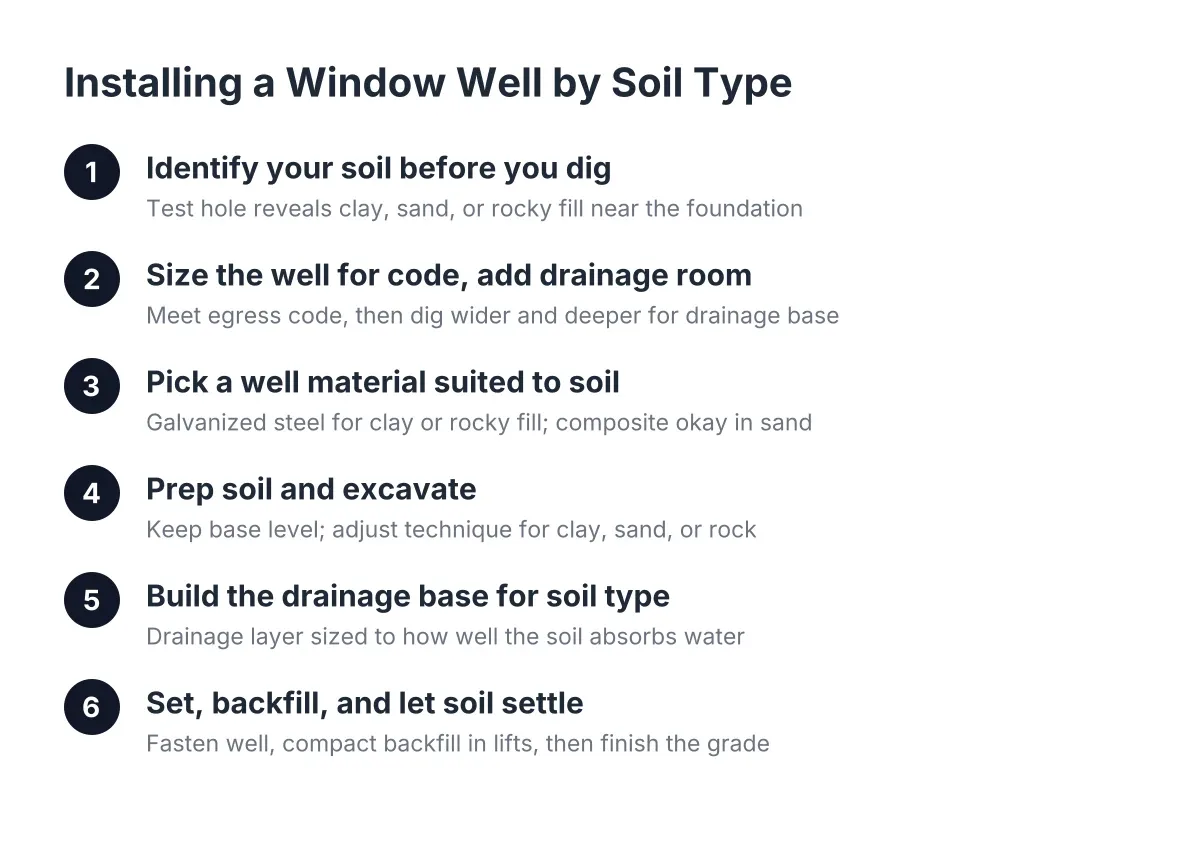
Step 4: Ask How the Installer Handles Minneapolis Frost and Soil
Frost depth in the Minneapolis area runs deep enough that frozen soil exerts serious pressure on anything buried beside a foundation. A local installer should explain, without prompting, how the well and backfill handle freeze-thaw cycles. A regional contractor quoting from a national script often cannot.
Two details signal local knowledge. First, excavation size: digging only a couple of inches wider than the well on each side means less backfill, less tamping, and less risk of soil settling and funneling water toward the house later. Second, well placement: the top of the well should sit just under the overhanging siding, so rainwater running down the wall drains past the cover instead of pooling behind it.
Ask each bidder both questions. The answers tell you more than the price does.
Step 5: Compare the Numbers Against Verified Benchmarks
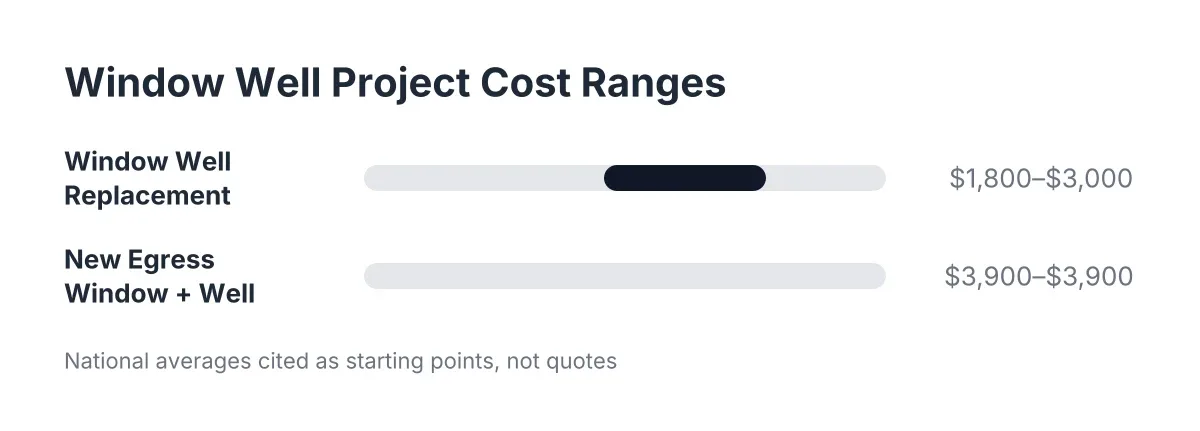
Now look at price, with real reference points. According to Angi, installing a window well alone runs from about $500 to $1,500 or more, while adding an egress window and well averages about $3,900. HomeAdvisor puts window well replacement at an average of $2,200, with most homeowners spending $1,800 to $3,000, and full egress window installation at an average of $4,229.
Suppose a seller in south Minneapolis gets three quotes to resolve an inspection item: one at $1,200 for a galvanized well swap with a new drain, one at $4,100 for cutting a full egress opening, and one at $700 with no drainage or sealing mentioned. The first two can both be fair; they describe different scopes. The third is the one to question, because the missing drainage work tends to reappear as a water problem after closing.
Pricing varies by project, so treat these figures as benchmarks, not promises. What matters is that each quote itemizes excavation, the well unit, drainage, sealing, backfill, and any ladder or cover, so you can compare the same scope across bidders.
Step 6: Look for Installation Quality Standards in Writing
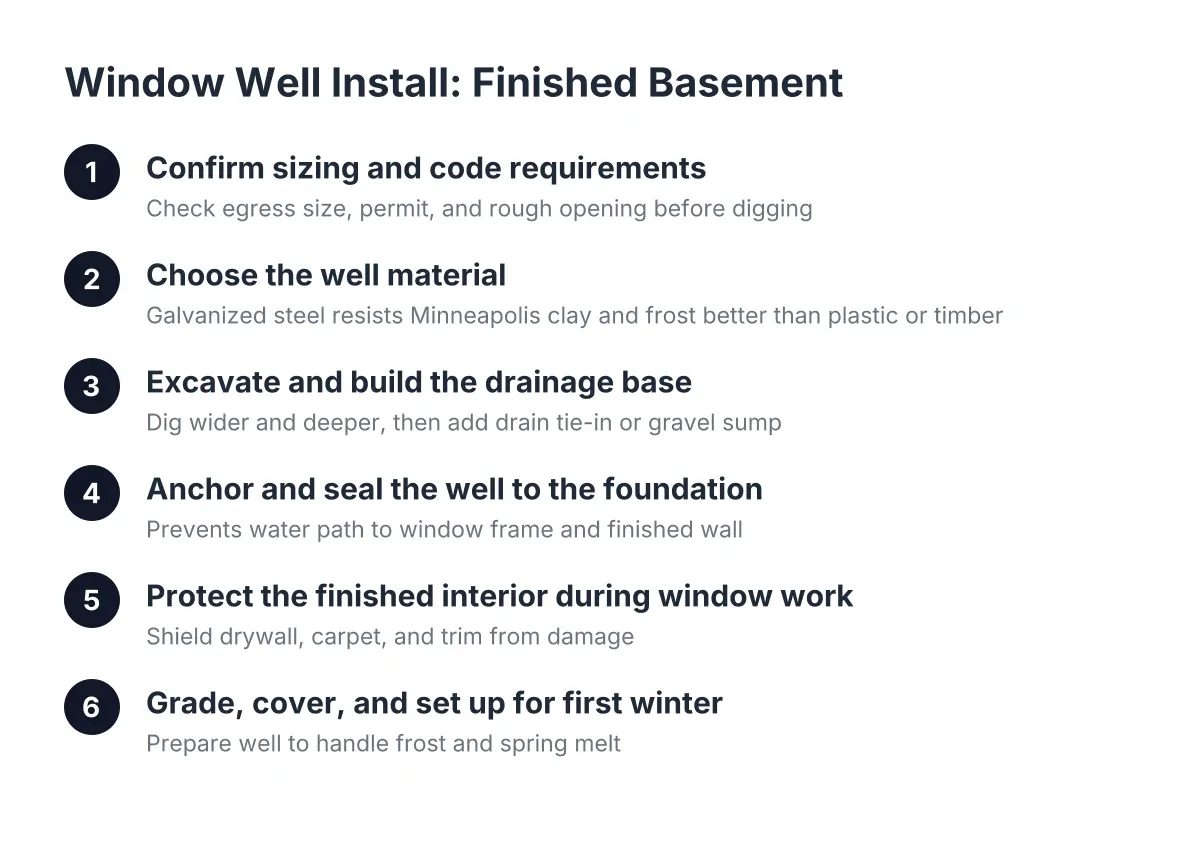
Finally, how you look at window well installation standards in the quote predicts how the crew will work on site. Good installers level and mark the well's position on the foundation before drilling a single anchor hole. They center a well that is wider than the window by measuring equal distances from each edge of the well to the window trim. When bolting, they level and tighten one side first, recheck it, then tighten the opposite side so the well does not end up crooked.
You will not see every step written out, but the quote or the conversation should cover anchoring method, leveling, and sealing. Ask directly: how do you fasten the well, and how do you keep it square to the window? A window installer who answers in concrete steps has done this on Minneapolis foundations before.
One honest caveat: if your foundation shows cracks, bowing, or active water intrusion near the window opening, bring in a structural or waterproofing professional before any well goes in. A new well bolted to a failing wall fixes nothing, and no window contractor should pretend otherwise.
A Quick Checklist Before You Sign
For a seller on a closing deadline, here is the short version of what a complete quote contains:
- Clear scope: well replacement, basement window replacement, or full egress upgrade
- Named material and dimensions, such as a galvanized egress window well with the projection and depth listed
- A drainage plan: drain tile tie-in, gravel sump, or a solid sealed cover
- Sealing where the well meets the foundation
- Excavation and backfill approach suited to clay soil and frost
- Itemized pricing you can compare line by line
- A realistic install date that works with your closing
Get two or three quotes against this list and the random-feeling price spread starts to make sense. The bids stop being mystery numbers and become different answers to the same checklist, which is exactly the position you want to negotiate from before closing.
If you need basement egress window installation, Minneapolis Window Pros can help.
Prefer to talk it through? Call (612) 482-9787 — a quick call is usually the fastest way to get a straight answer for your situation.