Window Replacement Contractors in Minneapolis: Questions to Ask Before You Hire
Your home inspection came back, and the basement windows got flagged. Maybe the frames are rotted, maybe the glass block is cracked, or maybe the bedroom downstairs does not meet egress code. Now the buyer wants it fixed before closing, and you are calling window replacement contractors with no idea what a fair price looks like or how long the work takes. That is a stressful spot. The closing date is set, the buyer's agent is watching, and every day without a real quote feels like leverage slipping away.
Here is the good news. You do not need to become a window expert in a week. You need to ask the right questions, and you need to know what a straight answer sounds like. This guide walks through both, with a focus on Minneapolis homes and the basement window issues that show up on inspection reports here more than anywhere else in the house.
Why Basement Windows Show Up on Inspection Reports
Most Minneapolis homes built before 1990 have basement windows that were fine when the house was built and are a problem now. The old steel or wood frames rust and rot. Glass block gets cracked or the mortar fails. Window wells fill with dirt and pull away from the foundation. None of this is unusual, and none of it means your house is falling apart.
However, inspectors flag these windows for two reasons, and it helps to know which one you are dealing with.
The first is condition. A cracked pane, a rotted frame, or a window that will not open is a repair item. It shows up on the report as damage or deferred maintenance. This is usually the cheaper fix.
The second is code compliance, and this is the one that changes the conversation. If the basement has a bedroom, or the listing calls a room a bedroom, that room needs a legal escape route. Minneapolis code requires each bedroom below the fourth floor to have a window at least 20 inches wide by 24 inches high, with nothing blocking it, according to the City of Minneapolis. If the current window does not meet that standard, a repair does not solve the problem. The opening itself has to change, which means cutting the foundation, installing an egress window, and adding a window well.
Knowing which situation you are in matters before you call anyone. A contractor quoting a basement window replacement and a contractor quoting an egress cut-in are quoting two different jobs at two different price levels. If you do not know which job you need, quotes will look random, because they are answering different questions.
What Window Replacement Contractors Should Include in a Quote
A complete quote from a window replacement contractor covers the window itself, removal of the old unit, installation, sealing and insulation, interior and exterior finish work, and haul-away of the old materials. For egress work, it should also cover excavation, the foundation cut, the window well, and any permit costs. If a quote is one number with no breakdown, ask for the breakdown.
Here is what a solid scope of work looks like for a standard basement window replacement:
- Measure each opening individually, not from a standard size chart
- Pull the old unit, frame and all if it is a full-frame replacement
- Prep and square the opening
- Set, shim, and fasten the new window
- Insulate and seal the gap between window and opening
- Finish the interior and exterior so it looks done, not patched
- Haul away the old window and debris
For an egress window installation, add excavation next to the foundation, cutting or enlarging the concrete opening, setting the window well, and grading so water drains away from the house. Window well installation is not an afterthought; a well that holds water against your foundation creates the next inspection problem.
Things that are often extra, and worth asking about up front: interior trim or drywall repair inside a finished basement, replacing a rotted sill or buck, drainage rock or a drain connection at the bottom of a window well, and well covers. None of these are unreasonable add-ons. The problem is finding out about them after the work starts, when your closing date leaves no room to negotiate.
What Does Basement Window Replacement Cost Before a Sale?
Basement window replacement cost depends on whether you need a like-for-like swap or a code-driven egress upgrade. A simple replacement in an existing opening is the smaller job. Cutting a new egress opening with a window well is the larger one, since it involves concrete work and excavation, not just a window.
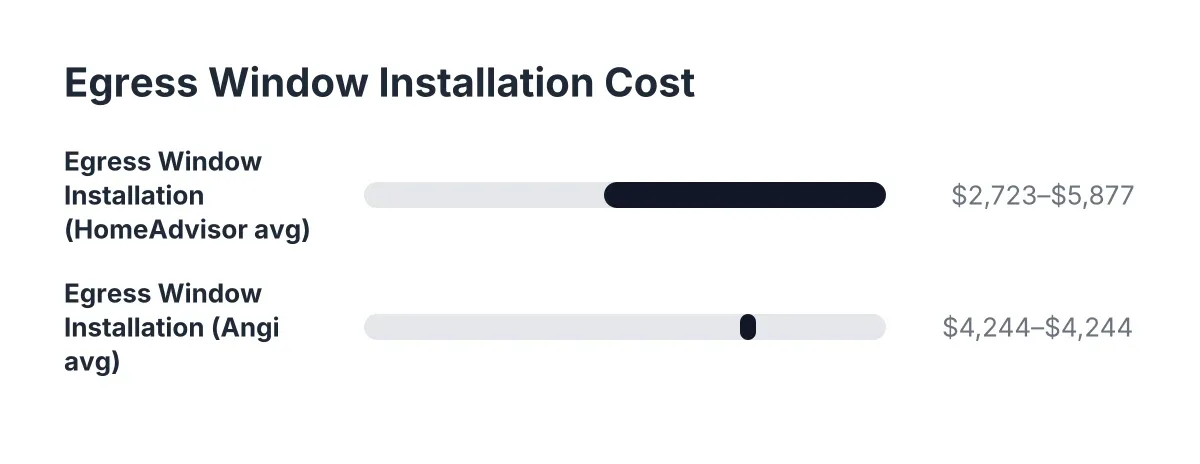
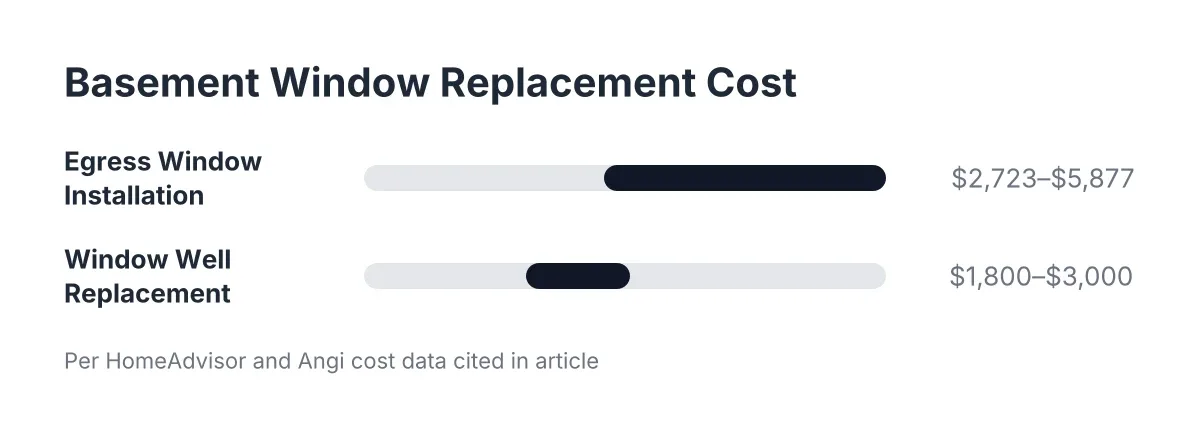
For the bigger job, third-party cost data gives you a useful sanity check. Installing an egress window costs an average of $4,229, with most homeowners spending between $2,723 and $5,877, according to HomeAdvisor. Angi reports a similar national average of $4,244 per window. If your quote for an egress cut-in lands far outside that band in either direction, ask why. There may be a good reason, like difficult access or unusual soil conditions, but the contractor should be able to name it.
Window wells have their own numbers. Window well replacement costs an average of $2,200, with most homeowners spending between $1,800 and $3,000, according to HomeAdvisor. That matters for pre-sale fixes because inspectors flag rusted or collapsed wells on their own, even when the window is fine.
Be careful with any window replacement cost calculator you find online. Those tools price a generic window in a generic wall. They do not know your foundation is poured concrete versus block, that your well sits under a deck, or that Minneapolis frost depth affects how the excavation and backfill get handled. Use calculators to set a rough mental range, then get a real quote based on your actual openings. A local installer who measures in person will always be closer to the true number than a form on a website.
One more pricing note for sellers. Whether it is cheaper to replace all windows at once depends on the job, but there is real logic to bundling. Mobilization, setup, and disposal costs get spread across more windows. If the inspection flagged two basement windows and you know the upstairs double-hung units are on their last legs, ask for a quote both ways. Sometimes fixing only the flagged items is the right pre-sale move. Sometimes doing four windows costs less per window and gives you a stronger answer to the buyer.
Seven Questions to Ask Window Replacement Contractors Before Hiring
You do not need dozens of questions. You need the ones that separate a contractor who knows Minneapolis basements from one reading a script. Ask these, and listen for specific answers.
-
Will you measure each opening in person before quoting? Basement openings in older homes are rarely square or standard. A replacement window has to be sized slightly smaller than the rough opening so it can be shimmed plumb and level. A contractor quoting off your phone photos is guessing, and a wrong-size window ordered on a guess can wreck a tight closing timeline.
-
Is this an insert replacement or a full-frame replacement, and why? An insert replacement keeps the existing frame and puts a new window inside it. A full-frame replacement removes everything down to the rough opening. If your frames are rotted, an insert is a patch over a problem, and a sharp buyer's inspector may call that out. You want the contractor to explain which one fits your situation, not just quote the cheaper option.
-
Does my basement window need to meet the bedroom egress requirement? This is the question that determines the whole project. If the basement room is a bedroom, the window has to meet egress code, and the Minneapolis Rental Property Checklist confirms that a proper egress window or door must open to the outside, per city code, according to the City of Minneapolis. A contractor who cannot walk you through egress sizing on the phone is not the contractor for a code-driven job.
-
Who pulls the permit, and does an inspection follow? For egress cut-ins and structural changes, permits matter, and a permitted, inspected job gives you paper to hand the buyer. That paper is worth real money in a repair negotiation. Ask directly whether the contractor pulls the permit or expects you to.
-
What happens with the window well? For below-grade windows, the well is half the job. Ask what style of well is included, how deep it will be dug, whether drainage rock goes in the bottom, and how the well attaches to the foundation. Galvanized egress window wells are a common, durable choice for Minnesota conditions. A quote that never mentions the well is incomplete.
-
How do you handle a finished basement? Window installation for finished basements takes more care. Drywall returns, trim, and flooring near the opening can get damaged during removal. Ask what interior finish work is included and what is on you. Getting this in writing prevents the classic surprise where the window looks great and the wall around it looks like a job site.
-
How long will the work take, start to finish? Not just the install day. Ask about measurement, window ordering lead time, permit timing if one is needed, and the install itself. A straight answer sounds like a sequence with rough durations. A vague "we'll get you in soon" is not something you can put next to a closing date.
How the Window Replacement Process Works on a Deadline
The window replacement process runs in a predictable order: measure, order, prep, install, finish, and inspect if a permit is involved. The long pole is usually the window order, since basement and egress windows in older Minneapolis homes are often custom sizes. Install itself typically takes a day or less per standard window; egress cut-ins take longer.
Suppose a homeowner in South Minneapolis gets an inspection report in March flagging two basement windows: one cracked glass block unit and one undersized window in a room the listing calls a bedroom. Closing is set for late April. In that scenario, the realistic path looks like this. Week one, a contractor measures both openings and confirms the bedroom window needs a full egress upgrade, not a repair. The glass block window gets a straightforward basement window replacement. The egress window gets ordered, the permit gets filed, and the excavation gets scheduled. Additionally, the block window swap happens in a morning. Furthermore, the egress cut-in, well installation, and backfill take longer, and the permit inspection closes it out with documentation the seller hands to the buyer's agent. Tight, but workable, if the contractor sequenced it honestly on day one.
That sequencing is why the timeline question matters so much. Frozen ground can complicate winter excavation for egress work, and window lead times stretch during busy seasons. As of 2026, none of that is a reason to panic; it is a reason to start quotes the week the inspection report lands, not the week before closing.
There is also a limit worth naming. If your foundation shows cracking, bowing, or active water intrusion around the window openings, get a structural or waterproofing professional involved before any window work. A new window set into a failing wall solves nothing, and a good window installer will tell you that instead of taking the job.
DIY Repair or Hire a Pro Before Closing?
Hire a professional for any pre-sale basement window work that involves the foundation, egress code, or a buyer's repair addendum. DIY makes sense for small items like re-caulking, replacing a screen, or clearing debris from a window well. Everything structural or code-related needs a pro, both for the work and for the paper trail.
The reason is not only skill. It is documentation. When a buyer's addendum says "repair or replace basement windows," a receipt from a licensed local installer, plus a permit record for egress work, closes the item cleanly. A homeowner's own weekend fix invites the buyer's inspector to look again, and a re-flagged repair two weeks before closing is worse than the original problem.
DIY basement window swaps also fail in predictable ways. Openings in old foundations are out of square, so a stock window rarely drops in cleanly. Manufacturer screw holes do not always line up with the wood buck behind the frame, so fastening takes judgment, not just a drill. New-construction windows come with nailing flanges that have to come off before the unit fits a masonry opening, and a wrong cut ruins the window. Each of these is routine for an installer and a costly surprise for a first-timer on a deadline.
What a Fair Quote Looks Like
A fair quote from window replacement contractors is written, itemized, and tied to measurements taken at your house. It names the window type, whether double-hung, casement, or glass block, states insert versus full-frame, includes disposal and finish work, and gives a schedule you can hold next to your closing date. For egress jobs, it covers the permit, the concrete cut, and the window well installation.
Just as important is what a fair quote does not do. It does not expire in 24 hours to pressure you. It does not carry a "today only" discount. Notably, it does not dodge the egress question. Pre-sale homeowners are the exact audience high-pressure sales tactics target, because the deadline is visible. A quote you can read, compare, and hand to your realtor is the standard; anything less, keep calling.
Get two or three quotes if the timeline allows. When they differ, the itemization tells you why. One contractor may include drainage rock and a well cover; another may not. One may quote an insert where another quotes a full-frame replacement. Those are scope differences, not random pricing, and seeing them side by side puts you back in control of the negotiation with your buyer.
If you are staring at an inspection report right now, the next step is simple. Get someone local to look at the actual openings and give you a real number. We replace and install windows on every floor of Minneapolis homes, with basement egress windows and window wells as a specialty, and quotes are free. Reach out, tell us what the inspector flagged and when you close, and we will give you a straight answer on what the fix involves and what it costs.
If you need basement egress window installation, Minneapolis Window Pros can help.
Prefer to talk it through? Call (612) 482-9787 — a quick call is usually the fastest way to get a straight answer for your situation.